

There are moments when time feels wonderfully ordinary, and then there are moments when every single hour seems to carry a little story of its own.
When a family is waiting to welcome a baby girl, for example, people start asking, “What time will it be in a few hours?” almost without noticing.
A grandparent may be counting down to a visit, a parent may be planning a hospital call, and someone else might simply be trying to work out when they should send their congratulations. Time suddenly becomes personal, not just numbers on a clock.
That is where an Hours From Now Calculator becomes surprisingly useful. Instead of staring at the clock and doing sleepy mental maths, you can add hours to a current time and quickly find the future time and, when needed, the date too. It sounds tiny, but getting the exact hour right can save a fair bit of confusion.
Whether you’re wondering what time will it be in 2 hours, planning a meeting, setting a reminder, or figuring out when something happens after midnight, this guide explains how the calculation works in plain English. No dramatic mathematics required, thankfully.
| Hours From Now Calculator – Add Hours | Result |
|---|---|
| Starting Time | Current time |
| Hours to Add | Enter the number of hours |
| Calculation | Current time + hours |
| Result | Future time and date |
| Useful For | Scheduling, reminders, appointments, planning |
What Is an Hours From Now Calculator?
An Hours From Now Calculator is a simple time calculator that tells you what the clock will show after a certain number of hours have passed. You enter the number of hours to add, and the calculator uses the current time as the starting point to produce a future time.
For example, if the starting time is 3:00 PM and you add hours equal to two, the result is 5:00 PM. That’s just basic hour addition, but the calculation becomes more interesting when you cross 12 AM, change the date, or work with a larger number of hours.
A good calculator can also handle time and date together. So if your calculation passes midnight, it won’t stubbornly leave you on the original date. The following day becomes part of the answer, which is exactly what you’d expect from a clock behaving properly.
How to Add Hours to the Current Time
The basic idea behind adding hours is refreshingly simple: start with the present time and move the clock forward by the required number of hours. If it is 11:00 AM and you need to calculate two hours from now, move one hour to noon and another hour to 1:00 PM.
So:
- 11:00 AM + 2 hours = 1:00 PM
- 3:00 PM + 2 hours = 5:00 PM
- 5:00 PM + 2 hours = 7:00 PM
This is called time addition or time arithmetic, and it works the same whether you’re calculating a reminder, appointment, journey, or something much more personal. The only part that can trip people up is when the clock reaches midnight, because the date has to move forward too.
Hours From Now Calculator: What Information Do You Need?
Most hours from now calculators need very little information, which is part of their charm. Usually, the calculator starts with the current time automatically and asks you for the number of hours you want to add.
The basic inputs are:
- Current time
- Starting time, if you’re calculating from a time other than now
- Number of hours to add
- Sometimes the current date
- Occasionally additional minutes for a more exact result
Once those values are entered, the calculator produces the calculator result, showing the future time and potentially the future date. No notebook, wall clock, or questionable mental arithmetic at 2 AM is required.
What Time Will It Be in 2 Hours?
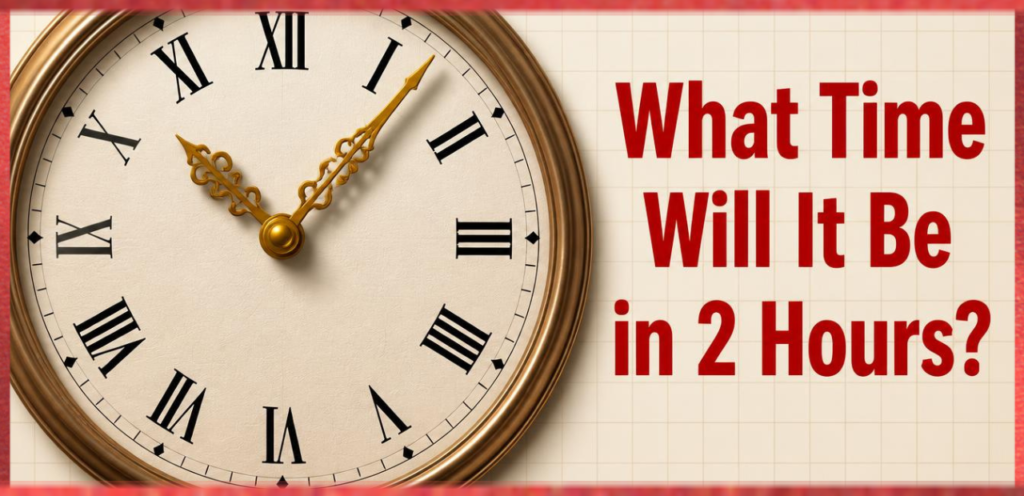
Suppose the clock says 5:00 PM. If you want to know what time it will be two hours later, simply move forward two hours.
5:00 PM + 2 hours = 7:00 PM.
The same principle works at nearly any point during the day. If it is 1:00 PM, two hours later is 3:00 PM. If it is 8:00 AM, two hours later is 10:00 AM. Easy enough, although tired brains have been known to turn 8 + 2 into an entirely different adventure.
The question what time will it be in 2 hours is one of the most common forms of this calculation because people often need quick answers for appointments, travel, cooking, exercise, work breaks, or planning activities.
Hours From Now Calculator and Crossing Midnight
Midnight is where a simple-looking calculation can suddenly become a date calculation too. Imagine it is 11:00 PM and you need to add two hours.
The first hour takes you from 11:00 PM to 12:00 AM. The second hour takes you to 1:00 AM.
Therefore:
11:00 PM + 2 hours = 1:00 AM on the following day.
Notice that the answer isn’t merely “1:00 AM.” The date has changed as well. This is known as crossing midnight, and it is one of the most important things to remember when doing a next day calculation.
A calculator handles this automatically, which is rather handy because humans tend to forget the date change when they’re concentrating on the clock.
How the 12-Hour Clock Works
Most everyday clocks use a 12-hour clock, dividing the day into AM and PM. AM covers the hours from midnight through late morning, while PM covers afternoon and evening hours.
For example:
- 1:00 AM is shortly after midnight.
- 11:00 AM is late morning.
- 1:00 PM is early afternoon.
- 11:00 PM is late evening.
When you’re adding hours to time, you may cross from AM into PM or from PM into AM. This is sometimes described as crossing AM and PM, and it can make mental calculations a little less automatic.
If you start at 10:00 AM and add four hours, you get 2:00 PM. If you start at 10:00 PM and add four hours, you get 2:00 AM the next day. Same number of hours, very different date situation.
24-Hour Clock and Military Time
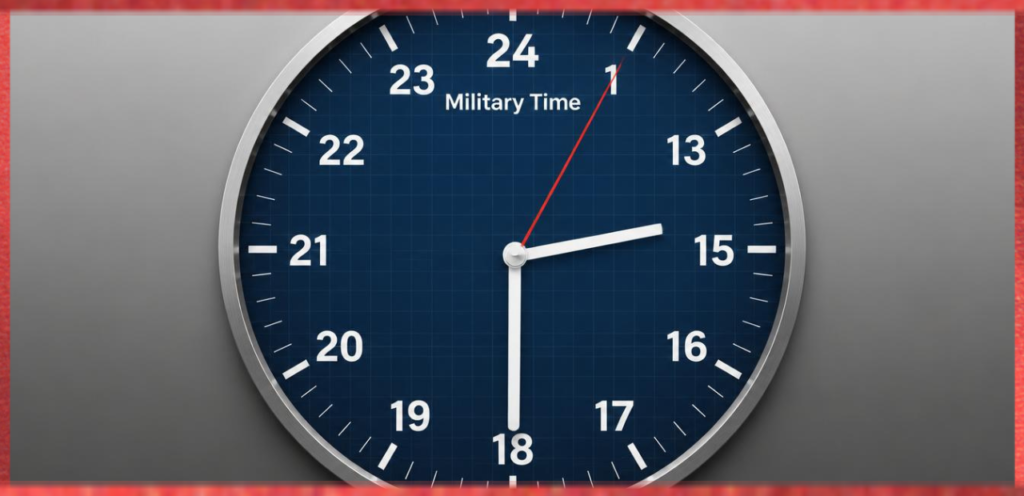
A 24-hour clock, often called military time, represents every hour from 00 through 23. Instead of resetting at 1:00 PM, the clock continues counting upward.
Some common conversions include:
- 1:00 PM = 13:00
- 5:00 PM = 17:00
- 9:00 PM = 21:00
- 11:00 PM = 23:00
- 12:00 AM = 00:00
This format is particularly useful for travel, healthcare, transportation, emergency services, and international communication because there is less chance of confusing AM with PM. A timetable saying 19:00 doesn’t leave much room for the “wait, was that morning?” moment.
A 24-hour to 12-hour conversion simply changes the display format without changing the actual moment in time.
How to Calculate Hours From Now Manually
You don’t always need a calculator. For a small number of hours, you can do the calculation mentally by moving forward one hour at a time.
Imagine the current time is 9:00 AM and you want to calculate five hours from now. Move forward:
9 AM 10 AM 11 AM 12 PM 1 PM 2 PM.
The answer is 2:00 PM.
For larger calculations, break the number into convenient pieces. If you’re adding 15 hours to 8:00 AM, add 12 hours first to reach 8:00 PM, then add the remaining three hours to reach 11:00 PM. This little trick makes time arithmetic much less fiddly.
Adding Hours When the Date Changes
If the number of hours is large enough, the calculation may move beyond the same day. This is where you need to consider both future time and future date.
For example, suppose the starting time is 6:00 PM on August 14 and you add eight hours:
6:00 PM + 6 hours = midnight
Midnight + 2 hours = 2:00 AM
The final result is 2:00 AM on August 15.
This is why an hours from now and date calculator can be more useful than a simple clock calculation. It keeps the time and date connected instead of treating them like two unrelated pieces of information.
Hours From Now Calculator: Example for August 15, 2026
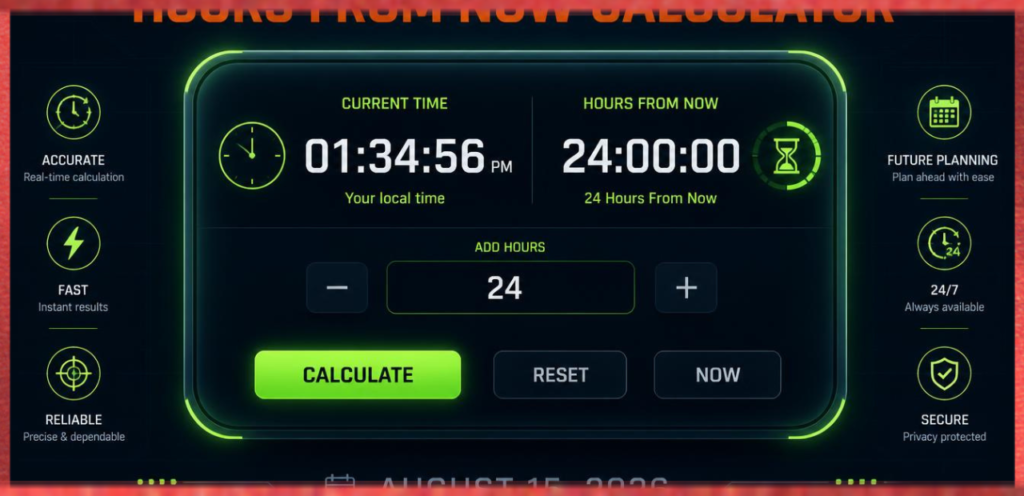
For a concrete example, consider a result showing 5:21 AM on Saturday, August 15, 2026. This kind of result tells you two pieces of information at once: the exact time and the corresponding date.
That can matter when you’re planning something around midnight, particularly if a reminder, event, appointment, or message needs to happen on the correct calendar day. A time without a date can occasionally be a little sneaky.
The exact result depends on the current time, time zone, and number of hours entered. Because of that, always use the local starting time relevant to the event rather than assuming another person’s clock is showing the same moment.
Adding Hours Versus Adding Minutes
Sometimes hours are too broad. You may need to know what happens 90 minutes from now, or perhaps 2 hours and 30 minutes from now.
Since there are 60 minutes in an hour, 90 minutes equals 1 hour and 30 minutes. A minutes from now calculator or minutes to hours converter can make these calculations quicker.
For example:
3:00 PM + 90 minutes = 4:30 PM.
This is still the same basic idea of time addition, just with a smaller unit involved. When exact scheduling matters, minutes can be just as important as hours.
Why Exact Time Calculation Matters
Being off by an hour may not matter when you’re casually deciding when to make dinner, but it can matter quite a lot for a flight, work meeting, medication reminder, online event, or appointment. Even a small error can create a surprisingly large mess.
Accurate exact time calculation is especially useful for:
- Scheduling meetings
- Setting reminders
- Planning appointments
- Organizing travel
- Planning activities
- Tracking work shifts
- Coordinating calls across time zones
- Estimating future deadlines
For families welcoming a newborn, timing can be especially unpredictable. One person may be waiting for an update, another preparing food, and somebody else trying to figure out when to leave home. A simple time calculation can bring a tiny bit of order to an otherwise wonderfully chaotic day.
Real-Life Examples of Adding Hours
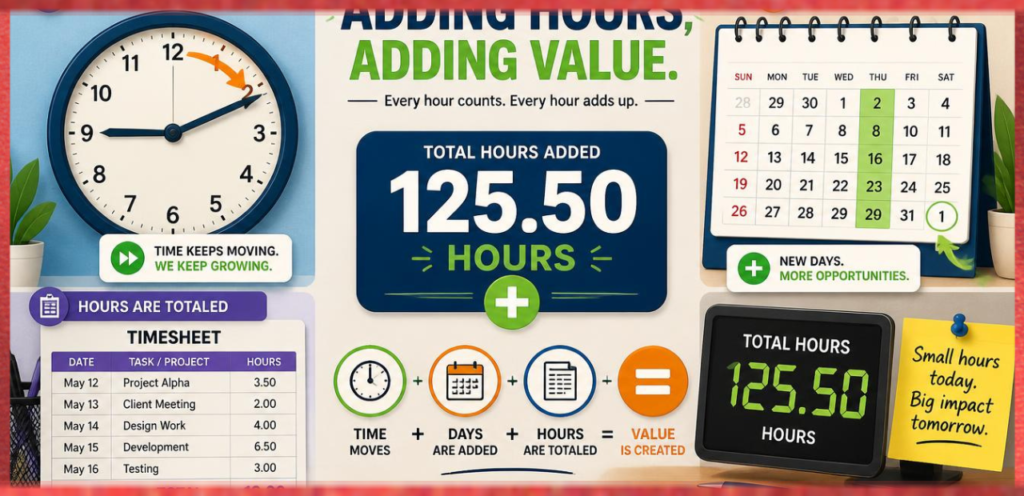
Here are several everyday examples showing how the calculation behaves:
- 3:00 PM + 2 hours = 5:00 PM
- 11:00 AM + 2 hours = 1:00 PM
- 1:00 PM + 5 hours = 6:00 PM
- 8:00 PM + 4 hours = 12:00 AM
- 11:00 PM + 2 hours = 1:00 AM the following day
- 1:00 AM + 6 hours = 7:00 AM
- 10:00 AM + 15 hours = 1:00 AM the next day
- 6:00 PM + 10 hours = 4:00 AM the following day
The pattern is simple once you stop trying to make the clock behave like ordinary addition. Time has its own little rules, and midnight is the cheeky one.
Using an Hours From Now Calculator for Scheduling
One of the easiest practical uses is scheduling meetings. Instead of calculating the future time yourself, enter the number of hours until the meeting or event and use the result to plan around it.
The same goes for setting reminders. If you know you need to remember something four hours from now, the calculator gives you a clear target time. This can be useful for cooking, study sessions, work tasks, travel preparation, or even remembering to send a thoughtful message to someone.
For planning activities, future time calculations are useful when several events need to happen in sequence. A morning appointment might be followed by lunch, then travel, then an evening event. Knowing the exact time at each stage helps the whole day fit together rather neatly.
How to Make a Time Calculation More Personal
Numbers are useful, but sometimes the reason behind the number is what really matters. If you’re calculating a future time because someone is waiting for a baby girl to arrive, for instance, the clock becomes part of a much bigger emotional moment.
Instead of simply writing, “I’ll call you in three hours,” you could say, “I’ll check in around 8 PM—I can’t wait to hear how everything is going.” The calculation gives you accuracy, while the message gives it warmth. That’s a better combination, really.
A short congratulations message can also be adapted to the moment:
- “Counting the hours until I can send my biggest congratulations on your beautiful baby girl.”
- “May the hours ahead be peaceful, joyful, and filled with tiny newborn moments.”
- “A new daughter has arrived, and suddenly every hour feels a little more precious.”
- “Sending warm wishes as your family begins this beautiful new chapter.”
These aren’t calculations, of course, but they show why people often search for future times during meaningful events. Time is rarely just time when somebody important is waiting.
Cultural Moments Around Welcoming a Baby Girl

Welcoming a daughter can be celebrated in countless ways around the world. Families may gather for a naming ceremony, prepare special foods, give blessings, visit the parents, or offer gifts for the newborn. The exact customs vary greatly between families and cultures, so there isn’t one universal way to celebrate.
What remains surprisingly universal is the desire to express good wishes. A grandparent might whisper a blessing, an aunt may send flowers, or friends may gather around the new parents with food and laughter.
In many families, the first congratulations are less about perfect wording and more about being present, even if the message comes out a little messy.
One lovely approach is to connect a time-based message with the occasion: “Every hour brings another reason to celebrate your little girl.” It feels personal without trying too hard, which is usually where the nicest messages live.
Related Time Calculators and Converters
An Hours From Now Calculator is useful, but it isn’t the only tool for working with time. Different situations call for different calculations.
Useful related tools include:
- Minutes From Now Calculator for calculating a future time in minutes.
- Minutes to Hours Converter for changing minutes into hours.
- Military Time Converter for working with a 24-hour clock.
- 24-hour to 12-hour time converter for changing formats.
- Time difference calculators for comparing two points in time.
- Date calculators for working with longer periods.
Using the right tool makes the answer clearer and reduces the chance of a small arithmetic mistake turning into a larger scheduling problem.
Frequently Asked Questions About Hours From Now
How do I calculate hours from now?
Take the current time and move forward by the required number of hours. If the calculation passes midnight, also move the current date to the following day.
What time will it be in 2 hours?
Add two hours to the current clock time. For example, 5:00 PM + 2 hours = 7:00 PM.
What happens when adding hours crosses midnight?
The clock moves into AM and the date advances by one day. For example, 11:00 PM + 2 hours = 1:00 AM on the next day.
How many minutes are in an hour?
There are 60 minutes in an hour. Therefore, 120 minutes equals two hours, while 90 minutes equals one hour and 30 minutes.
Can I add hours to a date?
Yes. When you add hours to a date, the calculation considers both the clock and the calendar. Large additions may move the result into the next day or even several following days.
Is military time the same as the 24-hour clock?
Generally, yes. Military time uses a 24-hour format, although conventions for writing and speaking the time can vary slightly between military and civilian contexts.
What is the difference between hours from now and hours ago?
Hours from now moves forward from the starting time into the future. Hours ago moves backward into the past. They’re basically opposite directions on the same timeline, which is kinda neat.
A Quick Method for Doing the Calculation Mentally
When you’re only adding a few hours, use the clock itself. Start at the current hour and count forward, remembering that 12 PM becomes 1 PM, and 11 PM becomes 12 AM.
For bigger numbers, separate complete 12-hour cycles from the remaining hours. Adding 12 hours keeps the same clock hour but changes AM to PM, or PM to AM. Adding another 12 hours brings you back to the original AM/PM position but potentially onto the next date.
This mental shortcut is useful when you don’t have access to an Hours From Now Calculator, although the calculator is still preferable when the date or exact minutes matter. Human brains are excellent at many things; remembering whether you crossed midnight while half-asleep isn’t always one of them.
How to Write a More Personal Time-Related Message
If your future-time calculation is connected to a message, don’t be afraid to make it sound like you. A little personal detail can transform a generic sentence into something somebody actually remembers.
Mention the occasion, the relationship, or what you’re looking forward to. Instead of “I’ll see you in three hours,” you might say, “I’ll be there in about three hours, and I already know I’m going to fall completely in love with that tiny new face.”
For congratulations, focus less on perfect poetry and more on genuine feeling. A simple “Congratulations on your beautiful daughter; I hope these first hours together are full of peace and happy tears” can mean far more than a polished paragraph copied from somewhere else.
Frequently Asked Questions
42 hours from now
42 hours from now means adding 42 hours to the current time. Since 42 hours is 1 day and 18 hours, the result will fall on the following day.
120 hours from now
120 hours from now is equal to 5 days. Add five full days to the current date to find the exact future date and time.
32 hours from now
32 hours from now means adding 1 day and 8 hours to the current time. The final result will usually fall on the next day.
7.5 hours from now
7.5 hours equals 7 hours and 30 minutes. Add 7 hours and 30 minutes to the current time to get the exact future time.
2 hours from now
2 hours from now simply means adding two hours to the current time. For example, 5:00 PM plus 2 hours is 7:00 PM.
Read this blog https://naxovater.com/57-in-inches/
Final Thoughts on Calculating Hours From Now
An Hours From Now Calculator may look like a very small tool, but it solves a very ordinary problem that appears in countless parts of life. It helps you calculate hours from now, add hours to a starting time, identify a future time, and account for a changing date when the clock crosses midnight.
The basic principle is easy: start with the current time, perform the necessary hour addition, and remember that a clock resetting at midnight also means the calendar has moved forward.
Whether you’re scheduling meetings, setting reminders, planning travel, or simply wondering what time is it a few hours from now, the same logic applies.
And sometimes the reason you’re watching those hours matters more than the calculation itself. Maybe you’re waiting for a celebration, preparing to meet someone, counting down to an appointment, or waiting for news that will change a family’s world. In those moments, each hour feels a little different.
So use the calculator for the numbers, but keep the human part for yourself. If those hours are leading toward the arrival of a precious baby girl, a long-awaited reunion, or any other meaningful moment, may the time pass gently and bring you exactly where you hope to be.
And if you have a favorite way of counting down the hours or a special time-related message that made somebody smile share it with others. Sometimes the smallest message arrives at exactly the right moment.