

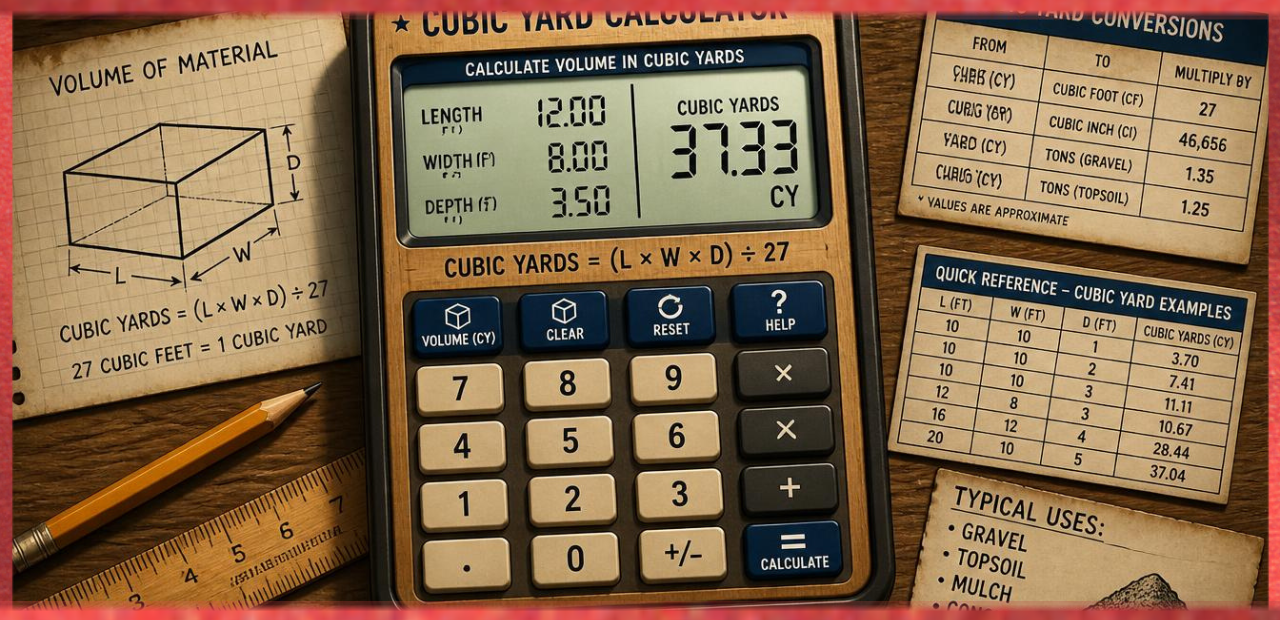
There is a funny little moment that happens during a landscaping or construction project: you look at a pile of gravel, dirt, concrete, or mulch and suddenly realize you have absolutely no idea how much material that actually is.
A few wheelbarrows can feel like a mountain, while a large truckload somehow disappears faster than expected. That’s where a Cubic Yard Calculator becomes genuinely useful.
Whether you are preparing a flower bed, ordering gravel for a driveway, estimating concrete for a slab, or filling an excavation with dirt, knowing the correct cubic yard quantity helps prevent expensive guesswork.
Nobody really wants to order five yards when four would do, and nobody wants to discover halfway through Saturday that one more delivery is needed either.
This guide explains cubic yardage, the basic volume formulas, unit conversions, material estimates, coverage, waste, and ordering tips.
You’ll also see practical examples so the numbers don’t just sit there looking mathematical and mysterious.
| Measurement | Formula / Result |
|---|---|
| Cubic yards | Length × Width × Height ÷ 27 |
| 1 cubic yard | 27 cubic feet |
| 1 cubic yard | 46,656 cubic inches |
| Cubic feet to cubic yards | Cubic feet ÷ 27 |
| Cubic yards to cubic feet | Cubic yards × 27 |
| Common materials | Dirt, gravel, sand, mulch, concrete |
What Is a Cubic Yard?

A cubic yard is a unit of volume equal to a cube measuring one yard in Length, Width, and Height.
In simple terms, imagine a box that is 1 yard long, 1 yard wide, and 1 yard high. Its total volume is one cubic yard.
Since one yard equals 3 Feet, one cubic yard is also:
- 1 yd × 1 yd × 1 yd
- 3 ft × 3 ft × 3 ft
- 36 in × 36 in × 36 in
- 27 Cubic feet
- 46,656 Cubic inches
- 0.9144 m × 0.9144 m × 0.9144 m
- 91.44 cm × 91.44 cm × 91.44 cm
That last comparison is handy when your measurements are in Metric units rather than SAE or another Standard measurement system.
A cubic yard measures space, not weight. This distinction matters a lot because a cubic yard of dry mulch and a cubic yard of wet soil can have very different weights, even though they occupy the same amount of space.
How Does a Cubic Yard Calculator Work?
A Cubic Yard Calculator takes the dimensions of a space and converts the resulting Volume into cubic yards. For a basic rectangular area, you need three measurements: Length, Width, and Height or depth.
The familiar volume formula is:
Volume = Length × Width × Height
If all three measurements are given in feet, the cubic yards formula becomes:
Cubic yards = (Length × Width × Height) ÷ 27
Why 27?
Because one cubic yard contains 27 cubic feet. So after calculating the volume in cubic feet, you simply divide by 27.
It sounds almost suspiciously easy, but thats really the whole trick for rectangular spaces.
How to Calculate Cubic Yards Using Feet
Suppose you have a landscaping area that is 12 feet long, 14 feet wide, and 0.75 feet deep.
First multiply the dimensions:
12 × 14 × 0.75 = 126 cubic feet
Then convert cubic feet to cubic yards:
126 ÷ 27 = 4.67 cubic yards
So the project requires approximately 4.67 cubic yards of material before considering waste or ordering practices.
This is the basic cubic yard calculation that works for many construction projects and landscaping projects. If your measurements are already in feet, there is no reason to make things harder than they need to be.
Cubic Yard Formula at a Glance
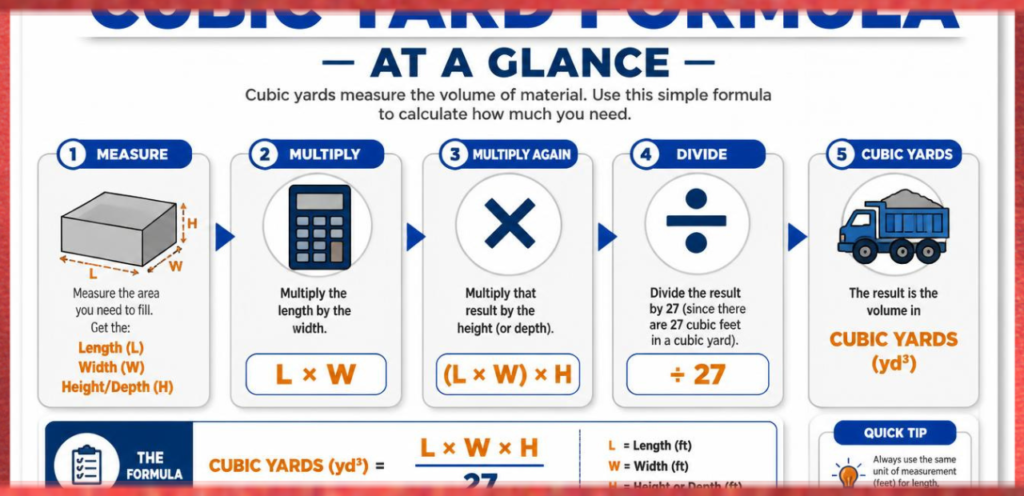
For a rectangular area, the cubic yard formula can be remembered as:
Cubic yards = L × W × H ÷ 27
Here:
- L = Length in feet
- W = Width in feet
- H = Height or depth in feet
- 27 = number of cubic feet in one cubic yard
For example:
20 ft × 10 ft × 0.5 ft = 100 cubic feet
Then:
100 ÷ 27 = 3.70 cubic yards
So you need about 3.7 cubic yards.
The important bit is that all dimensions must use the same unit before you multiply them. Mixing 10 feet with 12 inches without converting first is a sneaky way to produce a very confident, very wrong answer.
What Is One Cubic Yard?
One cubic yard is larger than many people imagine at first.
Picture a box that is:
- 3 feet long
- 3 feet wide
- 3 feet tall
That box contains exactly 1 cubic yard.
It also contains 27 cubic feet. In inches, it measures 36 inches on every side.
A useful cubic yard measurement chart looks like this:
| Measurement | Equivalent |
|---|---|
| 1 cubic yard | 27 cubic feet |
| 1 cubic yard | 46,656 cubic inches |
| 1 cubic yard | 1 yd × 1 yd × 1 yd |
| 1 cubic yard | 3 ft × 3 ft × 3 ft |
| 1 cubic yard | 36 in × 36 in × 36 in |
| 1 cubic yard | 0.764555 cubic meters |
That final conversion can be useful when working with international specifications or Metric measurements.
Converting Cubic Feet to Cubic Yards
The easiest cubic feet to cubic yards conversion is division by 27.
Cubic yards = Cubic feet ÷ 27
For example, if your project contains 216 cubic feet:
216 ÷ 27 = 8 cubic yards
So 216 cubic feet equals exactly 8 cubic yards.
Going the other direction is just as simple:
Cubic feet = Cubic yards × 27
Therefore:
8 × 27 = 216 cubic feet
Remember this little relationship and many volume calculations become much less annoying.
Converting Cubic Inches to Cubic Yards
Sometimes measurements are provided in Inches, especially for smaller construction components or containers.
There are 36 inches in a yard, but because volume is three-dimensional, you cannot simply divide cubic inches by 36. You need to account for all three dimensions.
One cubic yard contains:
36 × 36 × 36 = 46,656 cubic inches
Therefore:
Cubic yards = Cubic inches ÷ 46,656
For example, if a container holds 93,312 cubic inches:
93,312 ÷ 46,656 = 2 cubic yards
This is why a Conversion calculator can be helpful when your original measurements come in an unfamiliar unit.
What If Measurements Are in Inches?

If your Length, Width, and Height are given in inches, you can convert them to feet first.
For example, imagine a space measuring:
- 120 inches long
- 72 inches wide
- 6 inches deep
Convert each measurement to feet:
- 120 ÷ 12 = 10 feet
- 72 ÷ 12 = 6 feet
- 6 ÷ 12 = 0.5 feet
Now calculate:
10 × 6 × 0.5 = 30 cubic feet
Then:
30 ÷ 27 = 1.11 cubic yards
So the project requires approximately 1.11 cubic yards.
The lesson here is simple: convert inches to feet before applying the basic formula, unless you deliberately use a cubic-inch conversion.
Calculating Cubic Yardage for Landscaping
Landscaping is one of the most common reasons people search for a cubic yardage calculator.
Suppose you are spreading mulch over a rectangular Flower bed that is 18 feet long and 8 feet wide. You want a depth of 3 inches.
First convert 3 inches into feet:
3 ÷ 12 = 0.25 feet
Then:
18 × 8 × 0.25 = 36 cubic feet
Convert to cubic yards:
36 ÷ 27 = 1.33 cubic yards
So you need about 1.33 cubic yards of landscape material.
If the supplier only sells whole yards, you may decide to order 1.5 or 2 yards depending on the material, delivery policy, and expected settling.
Calculating Concrete in Cubic Yards
A concrete cubic yard calculator is particularly useful because concrete orders are often priced by cubic yard.
Imagine a slab that measures:
- 20 feet long
- 12 feet wide
- 4 inches thick
Convert 4 inches to feet:
4 ÷ 12 = 0.3333 feet
Then calculate the volume:
20 × 12 × 0.3333 ≈ 80 cubic feet
Now divide by 27:
80 ÷ 27 ≈ 2.96 cubic yards
The theoretical requirement is approximately 2.96 cubic yards of concrete.
In real construction, however, ordering exactly 2.96 cubic yards may be risky. Small variations in excavation, uneven ground, spillage, and other issues can affect the final requirement. A contractor may therefore include an appropriate allowance for Waste.
Calculating Gravel, Dirt, Soil, and Fill
The same basic calculation works for gravel, dirt, soil, sand, mulch, and Fill material.
For example, if a driveway area is 30 feet long, 10 feet wide, and 6 inches deep:
Convert 6 inches:
6 ÷ 12 = 0.5 feet
Calculate volume:
30 × 10 × 0.5 = 150 cubic feet
Convert to cubic yards:
150 ÷ 27 = 5.56 cubic yards
So you need approximately 5.56 cubic yards of gravel.
The material itself doesn’t change the mathematical volume. What changes is the weight, price, settling behavior, compaction, and sometimes the recommended waste allowance.
How Much Area Does a Cubic Yard Cover?
People often ask, “How much area does a cubic yard cover?”
There isn’t one universal answer because Area coverage depends on the depth.
A cubic yard spread thinly covers more square feet than the same cubic yard spread deeply. Thats just geometry doing its quiet little job.
The relationship is:
Area = Volume ÷ Depth
For one cubic yard:
Area in square feet = 27 ÷ depth in feet
For example, at a depth of 3 inches:
3 inches = 0.25 feet
27 ÷ 0.25 = 108 square feet
So one cubic yard covers approximately 108 square feet at a 3-inch depth.
At 6 inches:
27 ÷ 0.5 = 54 square feet
This demonstrates why cubic yard coverage always needs a depth attached to it. Saying “one yard covers 100 square feet” without mentioning depth is incomplete.
Cubic Yard Calculation for Irregular Areas
Not every project conveniently looks like a shoebox.
Real yards have curves, corners, slopes, circles, and odd shapes. For irregular areas, divide the project into smaller sections that can be calculated separately.
For example, you might split a landscaping project into three rectangular sections. Calculate the cubic yard volume for each section, then add the results.
If Section A requires 1.2 cubic yards, Section B requires 2.4, and Section C requires 0.8:
1.2 + 2.4 + 0.8 = 4.4 cubic yards
This method is simple but surprisingly powerful. You don’t need every project to become a geometry exam.
Calculating a Cylinder in Cubic Yards
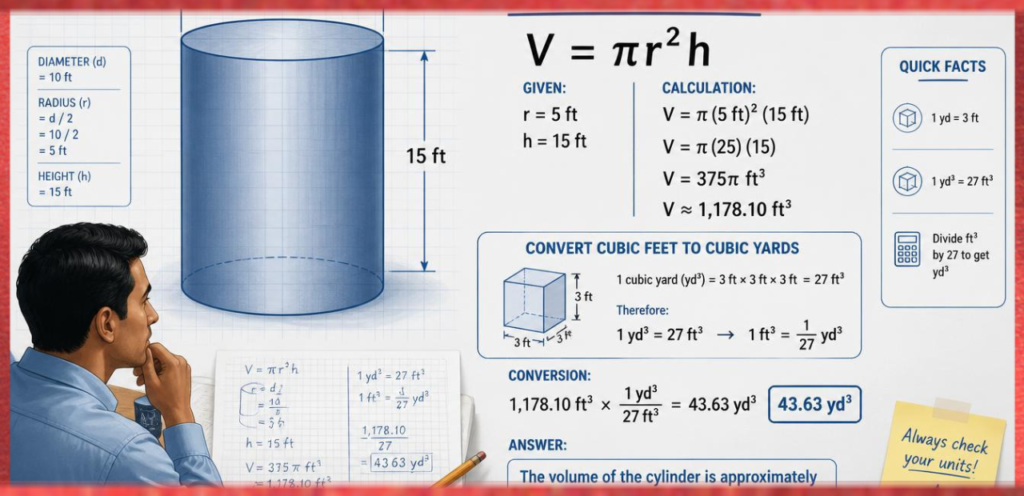
Some projects involve circular or cylindrical shapes rather than a Rectangular cuboid.
The cylinder volume formula is:
V = π × r² × h
Where:
- π = approximately 3.14159265359
- r = Radius
- h = height or depth
If you know the Diameter, remember that:
Radius = Diameter ÷ 2
So the formula can also be written:
V = π × (d ÷ 2)² × h
Suppose a circular excavation has a diameter of 10 feet and is 2 feet deep.
The radius is:
10 ÷ 2 = 5 feet
Then:
π × 5² × 2 ≈ 157.08 cubic feet
Convert to cubic yards:
157.08 ÷ 27 ≈ 5.82 cubic yards
This type of calculation is useful for round planting areas, cylindrical excavations, tanks, and other Geometric shapes.
Cubic Yards in a Truck Bed
A common question is how many cubic yards in a truck bed can fit.
The answer depends heavily on the dimensions and type of truck. A small pickup and a large dump truck are not remotely the same thing.
You can estimate a truck bed cubic yard capacity by measuring:
Length × Width × average depth ÷ 27
For example, a truck bed that is 6 feet long, 4.5 feet wide, and has an average loaded depth of 1.5 feet would have:
6 × 4.5 × 1.5 = 40.5 cubic feet
Then:
40.5 ÷ 27 = 1.5 cubic yards
A vehicle such as a Toyota Tacoma can carry a certain volume and weight depending on its specific configuration, but material weight is just as important as volume.
Gravel, wet soil, and concrete can become very heavy very quickly, so never assume that a physically fitting load is automatically a safe payload.
Ordering Material From a Supplier
Once you calculate cubic yardage, the next question is how much to actually order.
Suppose your calculation gives you:
4.67 cubic yards
You could order exactly 4.67 yards if your Supplier sells partial yards. Some suppliers do, while others use whole-yard increments.
If whole yards are required, you might round up to 5 cubic yards.
Rounding up can also account for minor Material waste, uneven spreading, settling, or measurement uncertainty.
But don’t automatically add a huge amount “just in case.” Too much leftover material is money sitting in your driveway wearing a different outfit.
For a large job, confirm the supplier’s minimum order, delivery charge, available increments, and whether the quoted Price per yard is based on loose or delivered material.
Estimating Cubic Yard Cost
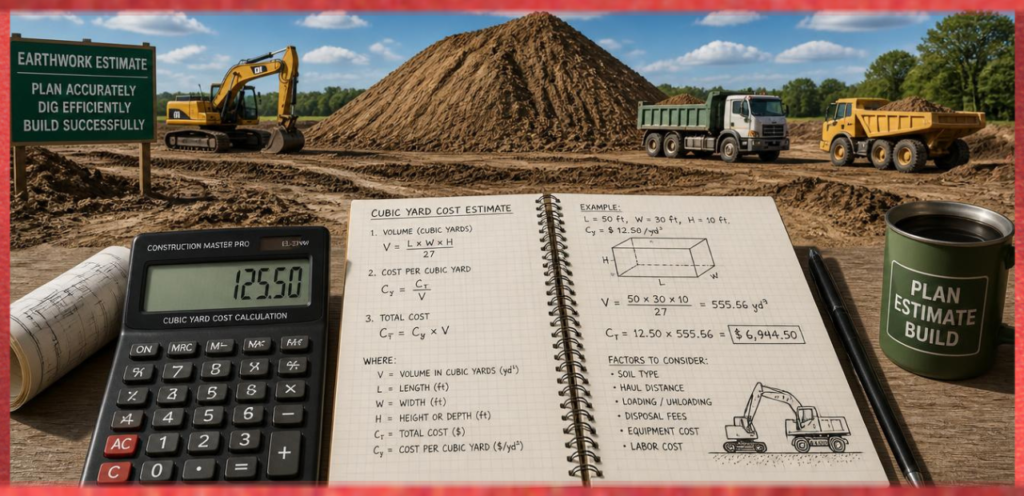
Once you know the quantity, estimating Material cost is straightforward.
The basic calculation is:
Total material cost = cubic yards × price per cubic yard
Suppose you need 6 cubic yards and the supplier charges $45 per yard:
6 × $45 = $270
Your estimated material cost is $270 before delivery, taxes, or other charges.
A complete landscaping material estimate may also include delivery, labor, equipment, installation, and disposal.
For construction projects, the same approach helps create a rough construction material estimate, though professional projects usually require more detailed specifications.
Why Waste and Rounding Matter
The number produced by a calculator is mathematical. Your actual project is not.
Suppose the calculation says:
7.14 cubic yards
That doesn’t mean 7.14 yards will always be enough. Ground conditions, compaction, moisture, spillage, uneven excavation, and measurement errors can all change the actual quantity.
For this reason, contractors commonly allow for an appropriate amount of waste or overage.
Still, the amount should be sensible. If your calculated requirement is 7.14 cubic yards, ordering 15 yards without a very good reason is not “being safe.” It’s probably just expensive optimism.
Common Measurement Mistakes
Even a good Measurement calculator can’t rescue incorrect measurements.
One common mistake is using inches in one dimension and feet in another without converting. Another is measuring depth inconsistently across a sloped area.
Watch for these problems:
- Mixing feet and inches
- Forgetting to convert depth into feet
- Dividing by the wrong conversion factor
- Confusing square yards with cubic yards
- Ignoring irregular shapes
- Forgetting material waste
- Assuming volume equals weight
- Rounding too early
- Measuring only one section of a multi-section project
Always keep your measurements organized before calculating. It takes less time than discovering the error after the delivery truck has already left.
Cubic Yard vs. Square Yard

These two measurements sound similar but describe different things.
A square yard measures area. A cubic yard measures volume.
A square yard is:
1 yard × 1 yard = 1 square yard
A cubic yard is:
1 yard × 1 yard × 1 yard = 1 cubic yard
The third dimension, depth, is what turns area into volume.
If you’re buying flooring, you’re often concerned with square footage or square yards. If you’re buying mulch, gravel, dirt, or concrete, you usually need a volume measurement such as cubic yards.
Cubic Yards to Tons
Another important distinction is between volume and weight.
A supplier may sell landscaping material by cubic yard, while another supplier may price it by the ton.
There is no single universal conversion from cubic yards to tons because the weight depends on the material and its condition.
For example, a cubic yard of lightweight mulch weighs much less than a cubic yard of gravel. Moisture can also make soil significantly heavier.
If you need to convert cubic yards to tons, use the supplier’s stated density or conversion factor rather than guessing.
This is especially important when transporting material because your truck has a maximum safe payload even if the bed physically has room for more.
A Quick Cubic Yard Calculation Example
Let’s bring everything together with one complete example.
Imagine you’re filling a rectangular area that measures 12 feet by 14 feet, with a depth of 0.75 feet.
First calculate volume:
12 × 14 × 0.75 = 126 cubic feet
Now convert:
126 ÷ 27 = 4.67 cubic yards
Therefore, the calculated requirement is approximately:
4.67 cubic yards
If the supplier sells whole yards, you may need to order 5 cubic yards. If the project has unusual depth variations or expected waste, you may need a slightly different quantity.
The calculator gives you the mathematical starting point. Practical judgment finishes the job.
Cubic Yard Measurement Chart

Here is a quick reference for common volume conversions:
| Cubic Yards | Cubic Feet | Cubic Inches |
| 0.25 | 6.75 | 11,664 |
| 0.5 | 13.5 | 23,328 |
| 1 | 27 | 46,656 |
| 2 | 54 | 93,312 |
| 3 | 81 | 139,968 |
| 4 | 108 | 186,624 |
| 5 | 135 | 233,280 |
| 10 | 270 | 466,560 |
This small chart can save a bit of time when you’re checking an estimate or talking to a landscape supplier.
How to Get More Accurate Measurements
Accuracy begins before the calculator does anything.
Measure the Length, Width, and Depth at several points when the ground is uneven. If the depth varies, use a reasonable average rather than measuring one convenient corner and pretending the rest of the project politely agrees.
For curved areas, use the appropriate geometry. For complicated projects, break the area into smaller sections.
You can also use a Scale conversion when working from drawings or plans. Construction documents may use different scales, so confirm the measurement units before beginning the cubic yard calculation.
When a Cubic Yard Calculator Is Most Useful
A Cubic Yard Calculator is especially helpful for:
- Concrete slabs
- Driveways
- Gravel paths
- Flower beds
- Mulch installation
- Soil replacement
- Garden beds
- Excavation fill
- Sand projects
- Drainage areas
- Construction excavation
- Landscape material ordering
It can also help homeowners compare supplier quotes because you can calculate the required Material quantity yourself before accepting a quoted amount.
That little bit of independence is useful. Numbers don’t get offended when you double-check them.
How to Use a Cubic Yard Calculator Correctly

For most rectangular projects, the process is short:
- Measure the Length in feet.
- Measure the Width in feet.
- Measure the Depth in feet.
- Multiply length × width × depth.
- Divide the result by 27.
- Add a reasonable allowance for waste if necessary.
- Round up according to the supplier’s ordering rules.
If measurements are in inches, convert inches to feet first. If they’re in meters or centimeters, convert the dimensions consistently before calculating, or use a suitable metric volume conversion.
For cylindrical spaces, use the cylinder formula instead of the rectangular volume formula.
Frequently Asked Question
cy calculator
A cy calculator helps you quickly calculate cubic yards from the length, width, and depth of a space. It’s useful for estimating soil, gravel, mulch, concrete, and other materials.
cu yd calculator
A cu yd calculator determines the volume of a project in cubic yards. Enter your measurements to estimate how much material you need.
dirt volume calculator
A dirt volume calculator helps estimate the amount of dirt or soil required for a landscaping or construction project. Simply provide the area dimensions and depth.
yardage calc
A yardage calc makes it easy to find the cubic yardage of an area before ordering materials. It can help reduce waste and prevent costly shortages.
cu yard calculator
A cu yard calculator converts your project measurements into cubic yards. It’s handy for calculating soil, sand, gravel, mulch, and other bulk materials.
Read this blog https://naxovater.com/what-time-was-it-9-hours-ago-2/
Final Thoughts on Cubic Yard Calculations
A pile of gravel doesn’t come with a measuring tape attached to it, unfortunately. That’s why understanding cubic yardage is so useful when planning landscaping and construction work.
The central idea is simple: calculate the Volume, make sure your units match, and convert that volume into cubic yards.
For rectangular spaces, multiply Length × Width × Height, then divide cubic feet by 27. For cylinders, use πr²h, followed by the appropriate conversion.
The numbers can look intimidating when you’re staring at a project that covers half the backyard, but the underlying process is pleasantly ordinary. Measure it, multiply it, convert it, then make a sensible decision about rounding and waste.
Whether you’re estimating cubic yards of concrete, cubic yards of gravel, cubic yards of dirt, soil, fill, or another landscape material, a reliable calculation can help you order the right amount and avoid unnecessary costs.
And perhaps thats the nicest thing about a Cubic Yard Calculator: it turns a vague question “How much stuff do I need?” into a number you can actually work with.