

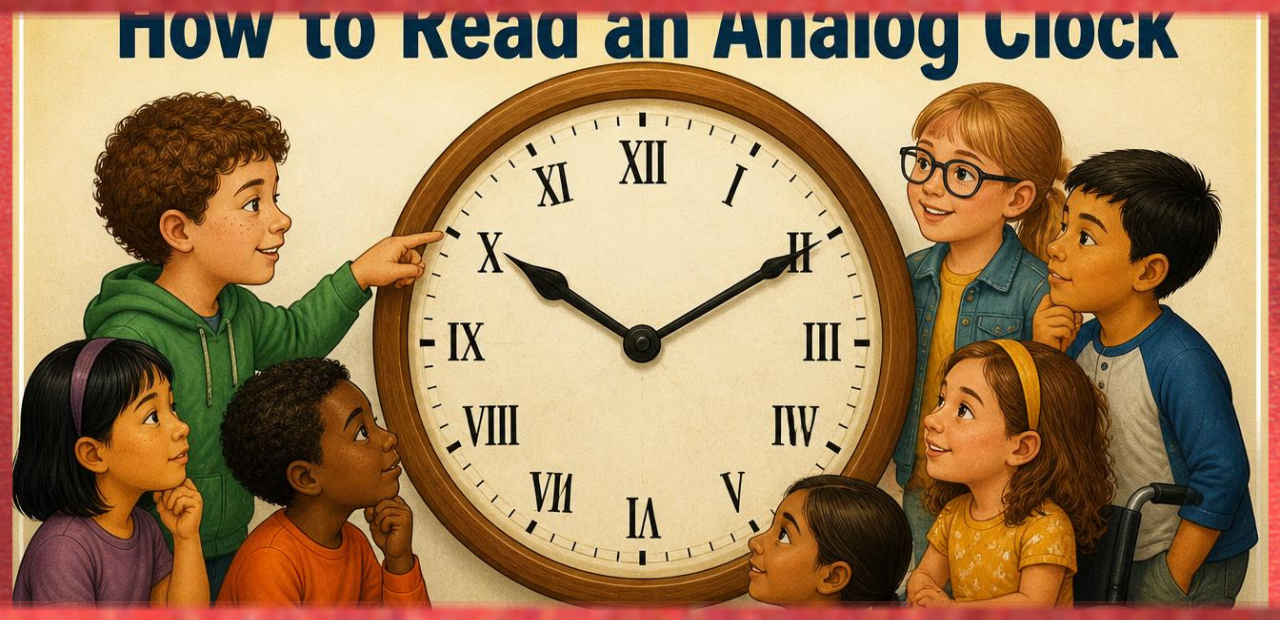
There is something oddly satisfying about looking at an analog clock and knowing the time without needing a glowing screen to tell you.
The hands move quietly, almost like they have their own little conversation, and once you understand that conversation, the clock face stops looking confusing.
It becomes simple, almost friendly. For many children, learning how to read an analog clock can feel tricky at first, but with a little practice the mystery usually disappears.
Maybe you remember an old wall clock in your grandparents’ home, ticking away during family conversations, birthdays, or those long afternoons when nobody seemed in a hurry.
That small ticking sound was part of the room. Learning how to tell time on an analog clock is not just a school skill either; it teaches children about numbers, patterns, movement, and patience. And yes, sometimes the hands seem to be conspiring against you, but they really aren’t.
| Clock Part | What It Shows |
|---|---|
| Short hand | Hour |
| Long hand | Minutes |
| Thin hand | Seconds |
| 1–12 numbers | Hours |
| Each number | 5 minutes on the minute hand |
| 12 position | :00 minutes |
| 3 position | :15 minutes |
| 6 position | :30 minutes |
| 9 position | :45 minutes |
| Clockwise | Normal direction of time |
| Counterclockwise | Opposite direction |
What Is an Analog Clock?

An analog clock is a traditional type of clock that shows time through moving hands rather than displaying the numbers directly as a digital readout.
Most clocks have a circular clock face, numbers from 1 through 12, and several tick marks around the edge.
The hands point toward different places on the face to show hours, minutes, and sometimes seconds.
Unlike a digital clock, which might show 11:25 using a straightforward numerical time display, an analog clock asks you to understand the position of hands.
That’s where the learning starts, and honestly, it can be kinda fun.The clock numbers usually represent the hours. Between each number are smaller markings that help you identify individual minutes.
Once you understand what each hand means, reading an analog clock becomes a matter of observing where the hands are pointing.
Understanding the Parts of an Analog Clock
Before learning how clock hands work, it helps to know what you’re looking at. The basic parts of an analog clock are surprisingly simple.
- The clock face is the round surface containing the numbers and markings.
- The hour hand is generally the shorter hand and shows the hour.
- The minute hand is usually longer and tells you the minutes.
- The second hand often moves faster and indicates the seconds.
- The clock numbers run from 1 to 12 around the face.
- Tick marks divide the clock into smaller intervals.
- The center point is where the clock hands are attached and rotate.
- The 12 o’clock position is at the very top of the clock.
- The 6 o’clock position is directly at the bottom.
- The 3 and 9 positions mark the right and left sides.
Different clocks can have different designs, of course. Some have Roman numerals, some have no numbers at all, and some have enormous decorative hands that look like they belong in a castle. But the underlying system remains pretty much the same.
How to Read an Analog Clock Step by Step
If you’re teaching a child how to read an analog clock, don’t begin by throwing every rule at them. Start with one hand, then add the next. The brain likes small victories, and clock reading gives you plenty of them.
Find the Hour Hand
The hour hand is normally shorter than the minute hand. Start by looking at its position.
If it points directly at 4, the hour is 4. If it points directly at 9, the hour is 9. Simple enough.
But here’s the sneaky part: the hour hand moves gradually between numbers as the minutes pass. So if the hour hand is between 4 and 5, the current hour is still 4 until the minute hand reaches the 12 and the hour becomes 5.
For example, if the hour hand sits slightly past 4 and the minute hand points to 2, the time is 4:10. The hour hand doesn’t wait politely until the next hour; it keeps moving.
Find the Minute Hand
The minute hand is generally the longer hand. To determine the minutes, look at the number it points toward and multiply that number by 5.
This is one of the most useful shortcuts when learning reading clock hands.
If the minute hand points to:
- 1 = 5 minutes
- 2 = 10 minutes
- 3 = 15 minutes
- 4 = 20 minutes
- 5 = 25 minutes
- 6 = 30 minutes
- 7 = 35 minutes
- 8 = 40 minutes
- 9 = 45 minutes
- 10 = 50 minutes
- 11 = 55 minutes
- 12 = 00 minutes
So if the hour hand is near 7 and the minute hand points at 8, the time is 7:40.
It sounds almost too easy after you see the pattern. The trick is simply to remember those five-minute intervals.
Look at the Second Hand
Some clocks also have a second hand, usually the thinnest hand and often the fastest-moving one. It completes one full rotation every 60 seconds.
The second hand isn’t always necessary when someone asks for the time. If someone says, “What time is it?” they usually mean hours and minutes. But when exact timing matters, you can also determine the seconds from its position.
There are 60 seconds around the clock, just as there are 60 minutes in an hour. Each small movement represents another second, though not every clock makes the individual second markings equally obvious.
The Easy Five-Minute Method
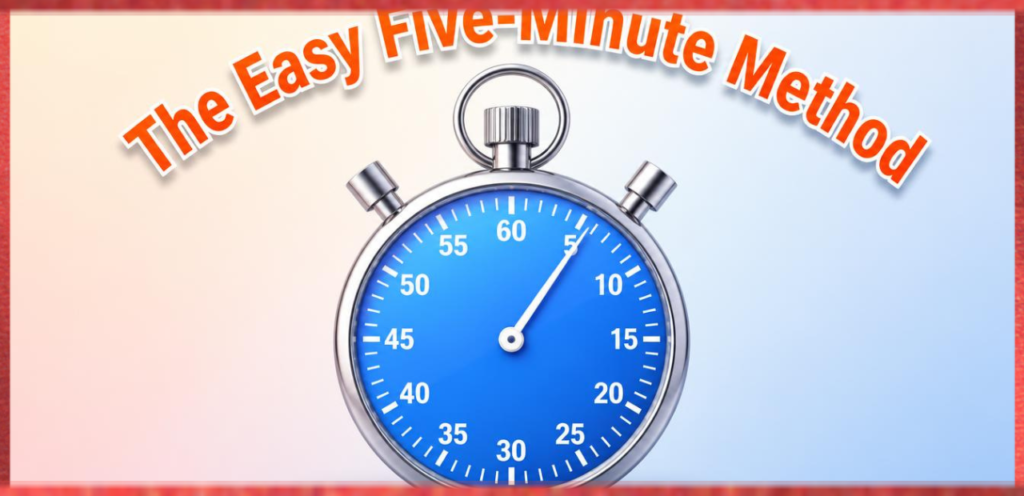
One of the simplest approaches to how to tell time on an analog clock is the five-minute method.
Start at the 12 o’clock position and move clockwise. Each major number represents another five minutes:
12 = 0, 1 = 5, 2 = 10, 3 = 15, 4 = 20, 5 = 25, and so on.
This makes the analog clock face almost like a multiplication table wrapped into a circle. Rather clever, really.
Suppose the minute hand points to 6. Multiply 6 by 5:
6 × 5 = 30 minutes.
If the hour hand is between 2 and 3, the time is approximately 2:30.
If the minute hand points to 10 and the hour hand has moved past 8, the time is 8:50.
The more you practice this pattern, the quicker your brain starts doing the calculation automatically.
How to Read Individual Minutes
The five-minute method works beautifully for basic time-telling, but what happens when the minute hand is between two numbers?
Look at the small tick marks.
On a traditional clock, there are 60 minute positions around the face. The larger numbers provide the five-minute landmarks, while the smaller markings represent individual minutes.
For example, suppose the minute hand is pointing at the third small mark after the number 4. Since 4 represents 20 minutes, three additional marks give you 23 minutes.
So the minute hand position would indicate 23 minutes.
This is how you can count minutes on a clock rather than relying only on the larger numbers. Once children understand this, more precise clock-reading skills usually become much easier.
How the Hour Hand and Minute Hand Work Together
The hour hand and minute hand don’t operate independently. They’re constantly moving together, but at different speeds.
The minute hand makes one complete rotation every hour. The hour hand takes 12 hours to make one complete rotation.
That means the hour hand position changes gradually throughout the hour. This is important because beginners sometimes look at the hour hand and simply choose whichever number it’s closest to.
That’s not always right.
If the hour hand is between 5 and 6 while the minute hand points to 3, the time is 5:15, not 6:15. The hour hand has started moving toward 6, but the hour hasn’t finished yet.
Understanding this relationship is one of the biggest steps toward confidently reading clock hands.
How to Read an Analog Clock at Common Times
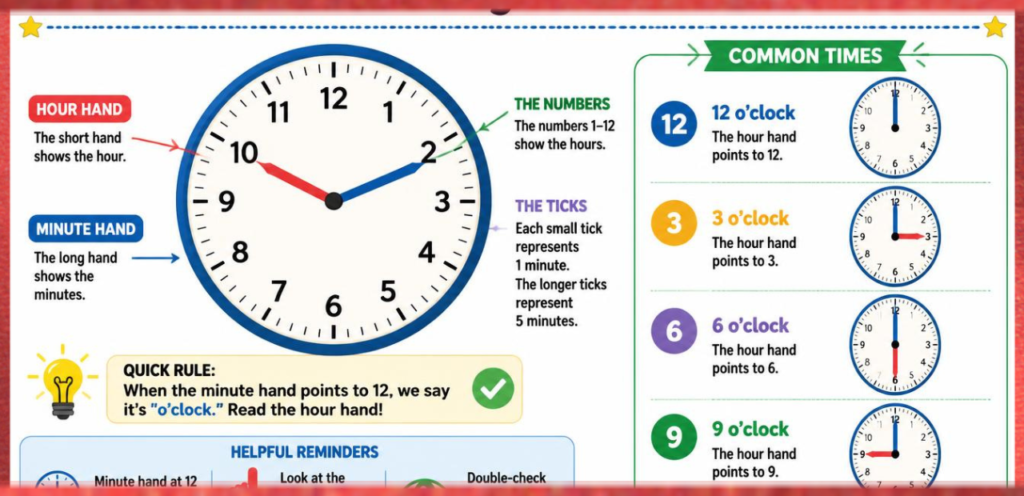
Some times are especially useful for practicing.
Reading 3:00
The hour hand points to 3, and the minute hand points to 12. The time is exactly 3:00.
The minute indication is zero because the minute hand is at the top.
Reading 3:15
The hour hand is slightly past 3, while the minute hand points to 3.
Because 3 × 5 = 15, the time is 3:15.
Reading 3:30
The minute hand points to 6, giving 30 minutes. The hour hand sits halfway between 3 and 4.
The time is 3:30.
Reading 3:45
The minute hand points to 9, representing 45 minutes. The hour hand is getting close to 4.
The time is 3:45.
These four examples create a useful mental map. Once they become familiar, other times tend to fit between them quite naturally, even if the first few attempts feel a bit wobbly.
What Do the Clock Numbers 1 to 12 Mean?
The clock numbers 1 to 12 represent the 12 hours in a standard cycle.
Starting at the top, you have 12, then moving clockwise:
1, 2, 3, 4, 5, 6, 7, 8, 9, 10, 11, and back to 12.
The clock repeats this cycle twice each day. That’s why an analog clock alone cannot tell you whether it is morning or evening unless you already know the context.
For example, a clock showing 7:00 could mean 7:00 AM or 7:00 PM.
A digital clock may solve this with a 24-hour display or AM/PM indicator, but an analog clock leaves that little piece of information to you.
Understanding the Rotation of the Hands
The rotation of hands follows a predictable pattern.
The second hand moves fastest, completing one circle in 60 seconds. The minute hand moves much slower, completing one circle in 60 minutes. The hour hand moves slower still, completing one circle in 12 hours.
Think of them as three runners on the same circular track. One is sprinting, one is walking briskly, and the other is taking a very relaxed stroll.
Their different speeds explain why the hands constantly change their relative position of hands. It also explains why the hour hand slowly shifts rather than jumping from one number to another.
Analog Clock vs. Digital Clock
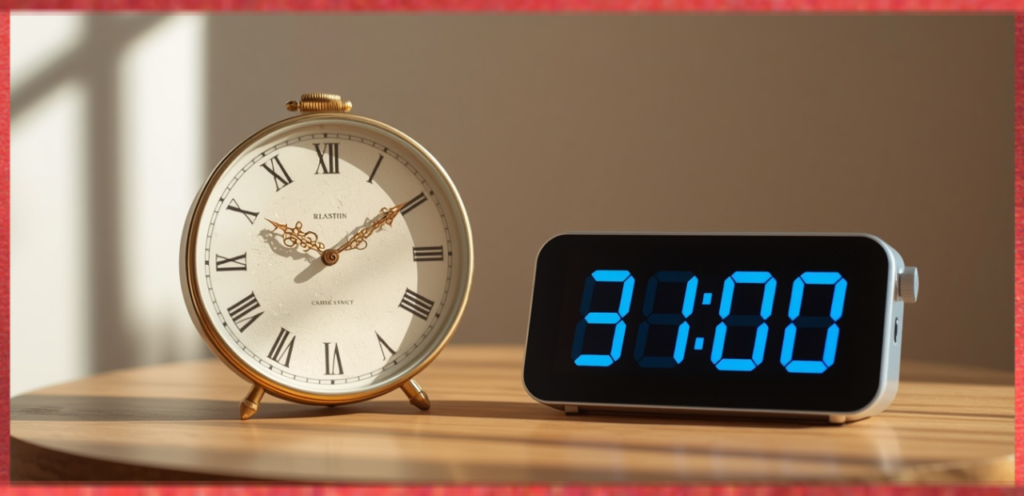
The biggest difference between an analog vs digital clock is how the time is represented.
An analog clock uses physical or graphical hands to show time. A digital clock uses numerical characters.
For example:
Analog: hour hand near 8, minute hand at 6
Digital: 8:30
The digital version is immediately obvious to most people, while the analog version requires interpretation.
But analog clocks offer something digital displays don’t always provide: a visual sense of how much time has passed or remains. Looking at the hands can make an hour feel like a physical slice of the circle.
The colon separator in a digital time such as 8:30 divides hours from minutes. On an analog clock, there is no colon. The hands perform that job visually instead.
How to Read Seconds on an Analog Clock
Reading seconds on an analog clock works much like reading minutes.
If the second hand points at 1, that’s approximately 5 seconds. If it points at 6, that’s approximately 30 seconds. If it points at 9, that’s approximately 45 seconds.
For clocks with individual second markings, you can count each tick mark to identify the exact second indication.
For example, if the second hand points to the fourth small tick after 7, you can identify the corresponding second by counting around the face.
Most everyday situations don’t require this level of accuracy, though. For cooking, school activities, appointments, or ordinary current time checks, hours and minutes are usually enough.
Common Mistakes When Reading a Clock
Learning clock-reading skills involves making mistakes. That’s not a bug in the process; it’s basically how learning works.
One common mistake is confusing the hour hand with the minute hand. Since the minute hand is usually longer, teaching children to identify length first can help.
Another mistake is reading the hour hand as the number it is nearest to. Remember, the hour hand moves gradually.
A third mistake is forgetting to multiply the minute number by 5. Seeing the minute hand at 8 doesn’t mean 8 minutes. It means 40 minutes on the standard five-minute landmarks.
People also sometimes count the 12 as five minutes instead of zero. At the top, the minute hand indicates 00 minutes when it points directly to 12.
And finally, don’t panic when the hands overlap. They haven’t broken the clock. They’re just occupying the same general direction for a moment.
A Simple Practice Routine for Children

If a child is learning how to read an analog clock, short practice sessions are usually better than turning the exercise into a long chore.
Start with whole hours.
Show 2:00, 6:00, and 10:00.
Then introduce half-hours.
Move to 2:30, 6:30, and 10:30.
Next, introduce quarter-hours such as 3:15 and 7:45.
After that, practice five-minute intervals.
Finally, introduce individual minute tick marks.
You can turn it into a little game. Ask, “If the minute hand moves from 2 to 5, how many minutes passed?” Or, “If it’s 4:20 now, what will the clock show in 15 minutes?”
These questions build genuine time-telling skills, rather than simply asking children to memorize clock pictures.
Use an Interactive Analog Clock for Practice
An interactive analog clock can make learning much more visual.
Instead of staring at a printed picture, learners can move the hands and immediately see how the time changes. This is especially useful for understanding the connection between hour hand position, minute hand position, and the passage of time.
For example, move the minute hand from 12 to 6 and watch the hour hand travel halfway toward the next number. That small movement makes an abstract idea suddenly visible.
An interactive tool can also help learners experiment with the current time on analog clock displays, compare different times, and practice converting clock positions into minutes.
The hands become less like mysterious sticks and more like moving instructions.
A Quick Clock Reading Checklist
When you need to read time from clock hands, use this simple checklist:
- Identify the shorter hand.
- Identify the longer hand.
- Check the number beneath the hour hand.
- See whether the hour hand has passed that number.
- Look at the minute hand.
- Multiply its number by 5 for a quick minute estimate.
- Count individual tick marks when exact minutes are needed.
- Check the second hand only when seconds matter.
- Combine the information into the complete time.
- If necessary, determine whether the time is AM or PM from the context.
It might feel like several steps at first. After enough practice, though, the brain compresses them into one quick glance. That’s when reading an analog clock starts feeling effortless.
Why Learning to Read a Clock Still Matters

With phones, computers, watches, tablets, and digital displays everywhere, someone might wonder why we still bother learning an analog clock.
The answer is simple: analog clocks teach relationships.
They help learners understand fractions, five-minute intervals, movement, sequence, angles, and elapsed time. The circular layout provides a visual model of an hour, while the rotation of hands shows that time is continuous rather than a collection of disconnected numbers.
There’s also something wonderfully practical about being able to look at a clock on a classroom wall, an old wristwatch, or a station platform and immediately understand it.
Technology changes. The basic idea of time doesn’t.
How to Get Better at Reading an Analog Clock
The best way to learn to read a clock is to look at real clocks regularly.
Don’t only practice from worksheets. Look at the clock when you wake up. Check it before lunch. Notice where the hands are when you leave home. Ask yourself what the time is before looking at your phone.
Try estimating the minutes before calculating them. Then check your answer.
You can also draw your own clock faces. Draw the numbers, add the clock hands, and challenge yourself to create specific times. If you’re helping a child, let them set the hands while you guess the time.
Little repetitions like these build confidence much faster than memorizing a page of rules.
Frequently Asked Question
Clock
A clock helps you check the current time quickly and understand hours, minutes, and seconds at a glance.
Clock With Seconds
A clock with seconds shows the exact time more precisely, including the seconds as they pass.
Analog Clock Face
An analog clock face uses numbered positions and moving hands to display the hour, minute, and sometimes second.
Interactive Clock
An interactive clock lets you adjust or explore the clock hands to understand different times visually.
Clock Interactive
An interactive clock provides a hands-on way to set, read, and practice telling time in real time.
Read this blog https://naxovater.com/how-many-days-until-may-21st/
Final Thoughts on How to Read an Analog Clock
Learning how to read an analog clock is really the art of turning movement into meaning. A short hand tells you the hour, a longer hand tells you the minutes, and sometimes a fast-moving second hand fills in the tiny details. Around the circular clock face, every number and tick has a purpose.
At first, the hands may look like they’re pointing everywhere except where you want them to. Give it time. Learn the hour hand, understand the minute hand, practice the five-minute pattern, and then work your way toward individual minutes and seconds.
Eventually, you’ll glance at an analog clock and know the current time almost before you’ve consciously thought about it.
And maybe that’s the nicest part of learning it. A clock isn’t really asking you to memorize a bunch of numbers. It’s teaching you to notice movement, sequence, and the quiet passing of one moment into another. Not a bad little lesson for something hanging on a wall.