

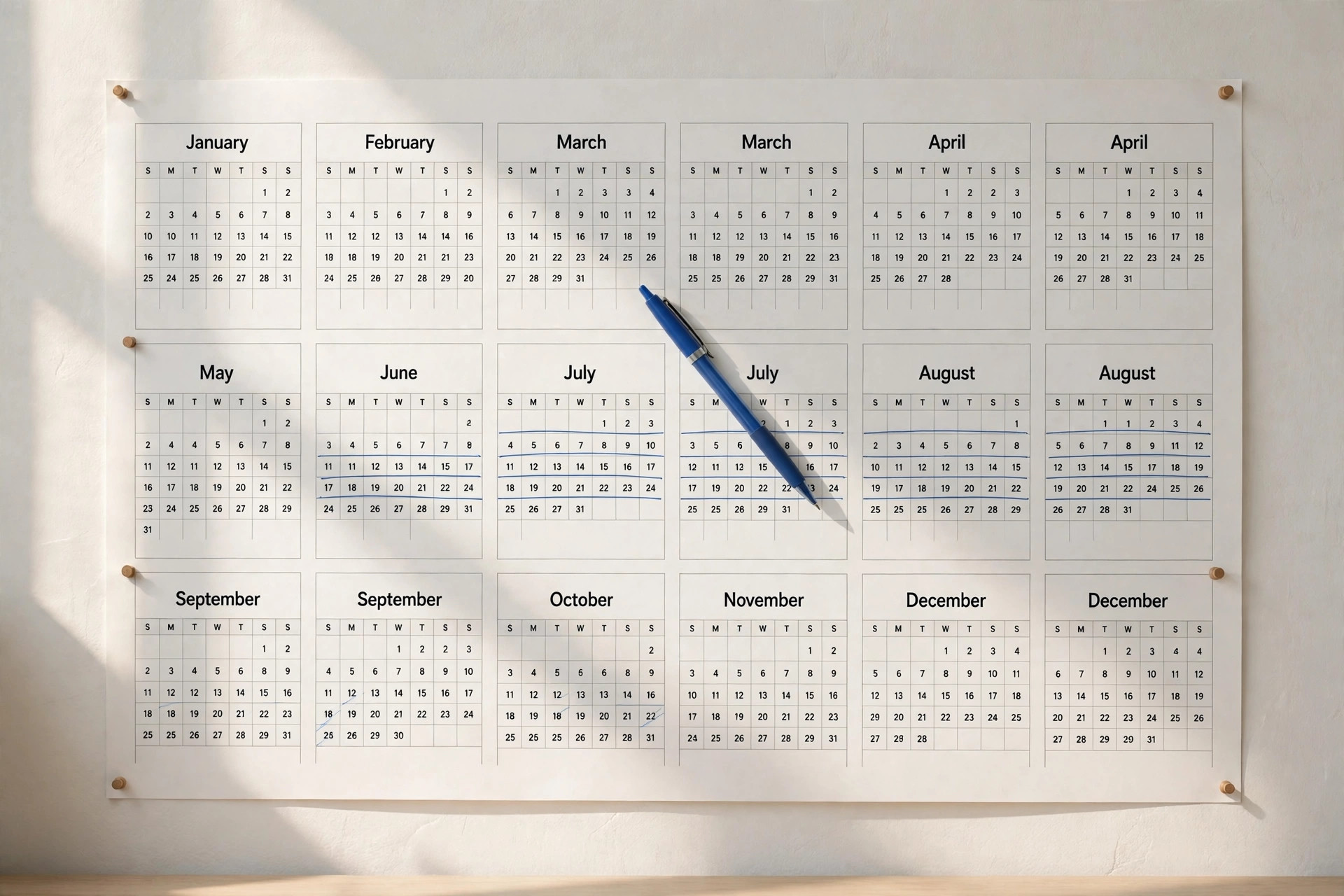
A year sounds like a simple unit, but counting it in weeks and months quickly raises questions. Why does a year have 52 weeks and not a neat number? Why do months have different lengths? And why does a ‘month’ sometimes mean four weeks and sometimes a calendar month? This guide explains how weeks and months are counted, and how to avoid the confusion they cause.
The Year in Days First
The starting point is the day. An ordinary year has 365 days, and a leap year has 366 days, with the extra day added as 29 February.
Weeks and months are both ways of grouping those days, but they group them differently, which is why the numbers never line up perfectly. Understanding that difference is the key to counting correctly.
Counting Weeks in a Year
A week has 7 days. If you divide an ordinary year by 7, you get:
365 divided by 7 equals 52 weeks with 1 day left over, because 52 multiplied by 7 is 364, and 365 minus 364 is 1.
A leap year gives:
366 divided by 7 equals 52 weeks with 2 days left over, because 366 minus 364 is 2.
That is why people say a year has 52 weeks. It is true in whole weeks, but there is always one extra day, or two in a leap year, that does not fit into a complete week. Those extra days are why the weekday of a given date shifts forward each year: 1 January falls one weekday later in the following year, or two weekdays later after a leap year.
Why some years are described as having 53 weeks
You may occasionally hear about a year with 53 weeks. This usually refers to a specific week-numbering system, often used in business and payroll, where weeks are numbered and a year can contain a 53rd week depending on which weekday the year starts on and how weeks are defined.
It does not mean the year has 53 complete weeks of 7 days, which would require 371 days. It means that, under that numbering system, days at the start or end of the year are grouped into a numbered week 53. For everyday planning, ’52 weeks plus one or two days’ is the clearer description.
Counting Months in a Year
A year always has 12 calendar months, but their lengths differ:
- January: 31 days
- February: 28 days, or 29 in a leap year
- March: 31 days
- April: 30 days
- May: 31 days
- June: 30 days
- July: 31 days
- August: 31 days
- September: 30 days
- October: 31 days
- November: 30 days
- December: 31 days
Adding those together gives 365 days in an ordinary year and 366 in a leap year. The uneven lengths are historical, inherited from the Roman calendar and adjusted over centuries, rather than designed for neat arithmetic.
This unevenness matters for planning. A ‘month’ from 15 January to 15 February is 31 days, because January has 31 days. A ‘month’ from 15 February to 15 March is 28 days in an ordinary year, or 29 in a leap year. Same word, different length.
Calendar Months Versus Four Weeks
One of the most common sources of confusion is treating a month as four weeks. Four weeks is 28 days, since 4 multiplied by 7 is 28. Only February in an ordinary year has exactly 28 days. Every other month is longer.
This distinction matters in several practical situations:
- Rent and subscriptions are usually charged by calendar month, not by four-week periods. A monthly payment covers the whole calendar month, whether it has 28, 30, or 31 days.
- A ‘month from today’ in everyday language usually means the same date next month, not 28 days later. For example, one month after 10 March is 10 April, which is 31 days later, not 28.
- Work schedules that repeat every four weeks will gradually drift away from calendar months. After a few cycles, a four-weekly event will fall on a different date in the month than it started on.
When a deadline or agreement says ‘one month,’ check whether it means a calendar month or a fixed number of days. If it is not clear, ask. The difference can be several days, which matters for payments, deliveries, and legal deadlines.
Quarters and Halves of a Year
Larger groupings are also common:
- A quarter is three calendar months. The year divides into four quarters: January to March, April to June, July to September, and October to December.
- A half-year is six calendar months: January to June, or July to December.
Quarters do not have equal lengths either, because the months inside them differ. The first quarter, January to March, has 90 days in an ordinary year, or 91 in a leap year. The second quarter, April to June, has 91 days. The third and fourth quarters have 92 days each. These small differences matter for financial reporting and for comparing periods fairly.
Practical Examples
Example 1: Weeks in a period
How many whole weeks are in 100 days? Divide 100 by 7: 14 weeks with a remainder of 2 days, because 14 multiplied by 7 is 98, and 100 minus 98 is 2. So 100 days is 14 weeks and 2 days.
Example 2: Months between dates
How many calendar months are between 5 May and 5 November? Count month by month: June, July, August, September, October, November is 6 months. The number of days in that period depends on the months involved, but the month count is exact.
Example 3: Why weekdays shift
If your birthday falls on a Monday this year, it will usually fall on a Tuesday next year, because the year has 52 weeks plus 1 extra day. After a leap year, it will shift by two weekdays instead, because of the extra leap day.
Frequently Asked Questions
Does every year have exactly 52 weeks?
In whole weeks, yes, but there is always 1 extra day in an ordinary year and 2 extra days in a leap year. A year is 52 weeks plus those extra days, not 52 weeks exactly.
Is a month the same as four weeks?
No. Four weeks is 28 days. Only February in an ordinary year is 28 days. Calendar months have 28, 29, 30, or 31 days.
Why do months have different lengths?
The lengths are historical, coming from the development of the Roman calendar and later reforms. They were not designed to be equal, and the Gregorian calendar kept them.
What is a quarter of a year?
Three calendar months. The four quarters are January to March, April to June, July to September, and October to December.
How do I count months between two dates?
Count from the same date in each month. For example, from 10 January to 10 July is 6 months. If the end date is earlier in the month than the start date, the last month is not yet complete.
Key Takeaways
- An ordinary year is 365 days: 52 weeks plus 1 day. A leap year is 366 days: 52 weeks plus 2 days.
- A year always has 12 calendar months, with lengths of 28, 29, 30, or 31 days.
- Four weeks is 28 days, which is shorter than most calendar months — do not treat them as the same.
- A ‘month from today’ usually means the same date next month, not 28 days later.
- Quarters are three calendar months each, but they do not have equal day counts.
Weeks and months are both useful, but they measure time in different ways. Once you know how each one is counted, you can switch between them without the confusion that catches so many people out.
Read next: How to Plan a Month Ahead