

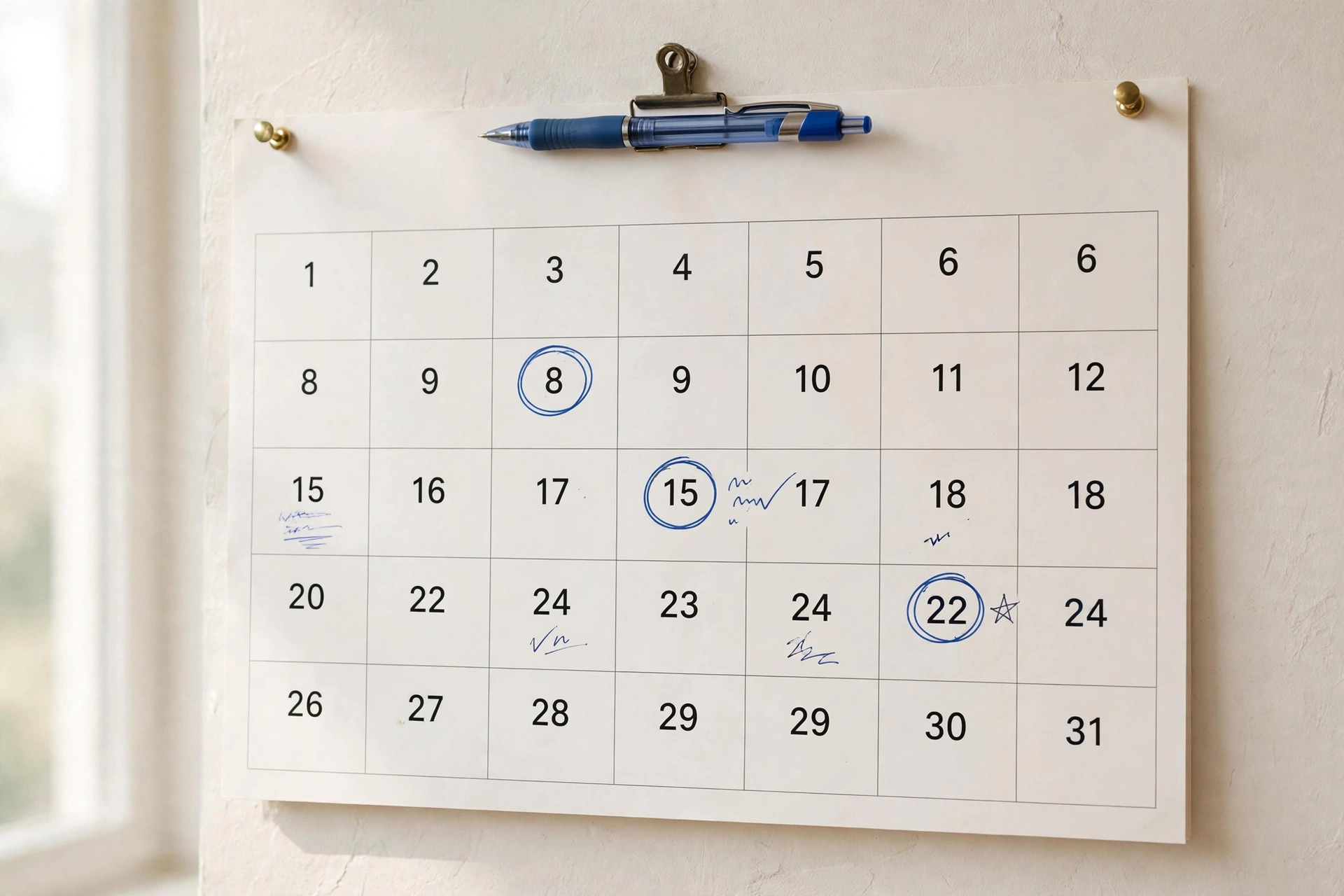
A month planned in advance feels very different from a month discovered one day at a time. Deadlines stop clashing, preparation happens before it is urgent, and there is room left for rest. This guide shows a practical way to plan a whole month: three passes over your commitments, weekly themes to give the month rhythm, and working-day counts so the workload actually fits.
Planning a Month in Three Passes
Trying to plan a whole month in one go can feel overwhelming. Three passes make it manageable.
Pass 1: Mark the fixed points
Start by marking everything that cannot move: appointments, deadlines, travel, recurring commitments, and important personal dates. These are the anchors of the month. Everything else must fit around them.
Use a consistent mark for fixed points — a colour, a symbol, or a bold entry — so they stand out at a glance. If a fixed point falls on a day you expected to be free, you will spot the clash early, while there is still time to adjust.
Pass 2: Add the preparation tasks
Next, work backwards from each fixed point and add the preparation it needs. If a presentation is due on the 20th, the preparation might belong on the 15th to 18th. If a trip starts on the 10th, packing and confirmations belong in the days before, not on the morning of departure.
This pass is where most planning failures happen, because preparation is easy to postpone. Putting it on the calendar turns a vague intention — “I should prepare sometime” — into a specific date.
Pass 3: Leave space for life
Finally, check that the month has breathing room. A calendar packed solid with tasks leaves no space for illness, delays, or simply rest. Aim to leave at least a few unplanned blocks each week, especially before major fixed points.
If the month looks overfull after three passes, something needs to move, shrink, or be dropped. It is better to make that decision calmly at the start of the month than in a rush halfway through.
Counting Working Days So the Plan Fits
Plans made in “days” and plans made in “working days” are different, and confusing them is one of the most common planning mistakes. A task that needs 10 working days takes two full working weeks, which is 14 calendar days if it spans two weekends, or more if it starts mid-week.
To check that a month’s workload fits, count the working days the month actually offers. In a typical Monday-to-Friday pattern, a 30-day month usually contains 21 or 22 weekdays and a 31-day month usually contains 22 or 23, depending on where weekends fall. A 28-day month contains exactly 20 weekdays. Then subtract any days lost to holidays, travel, or days you intend to keep free, and compare what is left with the work the month requires.
Be explicit about which kind of day you mean, especially when coordinating with others. A deadline “in 10 days” is not the same as “in 10 working days.” If the period includes two weekends, 10 working days is 14 calendar days. Writing “10 working days” instead of “10 days” prevents exactly the misunderstanding that causes missed deadlines.
The same check applies to individual tasks. A task planned for “the second Saturday” is a different date every month, because weekends fall on different dates each month. Write the actual date, not just the weekday description, so the plan survives contact with the real month.
Weekly Themes Inside the Month
A month is easier to manage when it has a weekly rhythm. Instead of treating all four weeks as identical, give each week a light theme based on what the month requires.
For example, in a month with a major deadline in the final week, the rhythm might be:
- Week 1: Decide and gather — confirm plans, collect materials, settle decisions.
- Week 2: Build steadily — do the main work in regular blocks.
- Week 3: Review and refine — check progress, fix problems, ask for feedback.
- Week 4: Finish and confirm — complete final tasks, confirm arrangements, and rest before the deadline.
The themes will differ for different months, but the idea is the same: each week has a purpose, so you are not trying to do everything in every week.
A weekly review helps too. Spend ten minutes at the end of each week checking what was completed, what moved, and what next week requires. That short review keeps the month plan alive, rather than letting it become a document you made once and forgot.
Planning Around Holidays and Disruption
Treat a public holiday like a weekend for planning purposes, unless you intend to work through it. Mark it early so that tasks depending on offices, schools, or services are not scheduled for a day when they are closed. The same applies to any day you know will be disrupted: a travel day, a moving day, or a day with a long appointment is not a full working day, even if it looks blank on the calendar.
When a task spans two months, split it at the month boundary. Note what must be finished by the end of the first month and what continues into the second. A task that “spans the month end” without a split point is easy to lose track of.
Common Month-Planning Mistakes
Counting calendar days as working days
A deadline “in 10 days” is not the same as “in 10 working days.” If the period includes two weekends, 10 working days is 14 calendar days. Be explicit about which one you mean.
Planning only the busy days
It is tempting to plan only the days with appointments and leave the rest blank. But blank days fill up quickly with unplanned tasks. Marking preparation and rest days on the calendar protects them from being swallowed by last-minute demands.
Assuming one month’s plan fits the next
A plan that works in a 31-day month may not fit in a 28-day month, because the shorter month offers fewer working days. Always re-count the working days before copying a plan from one month to another.
Packing the month solid
A month with no buffer absorbs no disruption at all. One delay then cascades into every later task. Leaving a few unplanned blocks each week is not wasted time; it is what keeps the plan intact when reality intervenes.
A Simple Month-Planning Checklist
Use this checklist at the start of each month:
- Mark all fixed appointments and deadlines.
- Add preparation tasks by working backwards from each fixed point.
- Count the working days available and check that the workload fits.
- Mark holidays and disrupted days so nothing depends on them.
- Leave buffer space, especially before major events.
- Set a weekly review time to adjust the plan as the month unfolds.
You do not need a complicated system to follow this checklist. A paper calendar, a wall planner, or a simple digital calendar all work, as long as you actually look at the month as a whole before it begins.
Frequently Asked Questions
How many working days are in a typical month?
It depends on the month’s length and where weekends fall. A 30-day month usually has 21 or 22 weekdays, and a 31-day month usually has 22 or 23, assuming a Monday-to-Friday pattern. Count the actual month rather than assuming.
Should I plan the whole month or just week by week?
Both. Plan the month’s fixed points and major tasks at the start, then refine week by week. The month view prevents clashes; the weekly view keeps the plan realistic.
What if a month has a holiday in the middle?
Treat the holiday like a weekend for planning purposes, unless you intend to work through it. Mark it early so that tasks depending on offices, schools, or services are not scheduled for a day when they are closed.
How do I handle a task that spans two months?
Split it at the month boundary. Note what must be finished by the end of the first month and what continues into the second. A task that “spans the month end” without a split point is easy to lose track of.
Key Takeaways
- Plan in three passes: fixed points, preparation tasks, then breathing room.
- Count working days separately from calendar days, and check the workload fits.
- Give each week a theme so the month has a rhythm, not just a list.
- Mark holidays and disrupted days early so nothing depends on them.
- Review weekly and adjust — a plan that never changes is a plan that stops being useful.
A month planned this way is much calmer than a month discovered one day at a time.