

Sometimes a date sits quietly on the calendar until somebody gives it a little meaning. A baby girl may arrive, for example, and suddenly six weeks, eight weeks, or twelve weeks later feels like a tiny milestone worth remembering.
Maybe it is the day you plan a family gathering, send a newborn blessing, schedule an appointment, or simply look back and say, “How did those weeks fly by so fast?”
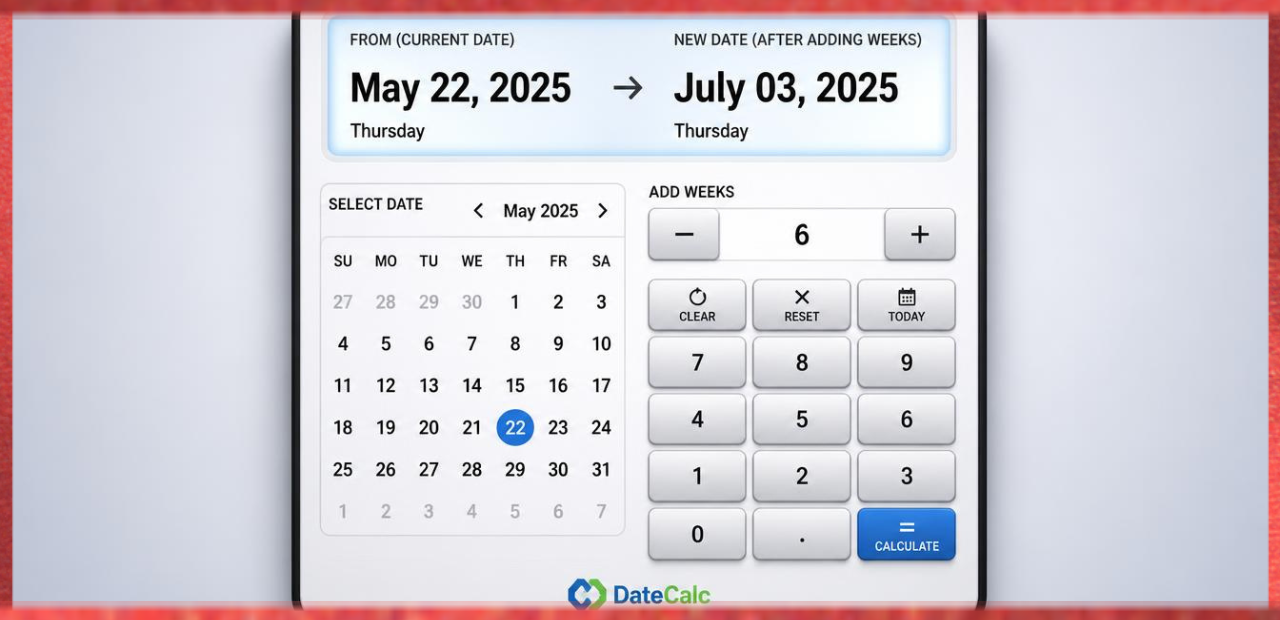
A Weeks Calculator makes those little date questions much easier, because it lets you Add Weeks to Date without wrestling with a calendar at midnight.
If your Start Date is known and you have a desired Number of weeks, the calculation is pleasantly simple. One week is seven days, so you can turn Weeks into Days and then move forward or backward on the Calendar.
It sounds almost too ordinary, but date arithmetic has a funny habit of becoming confusing when months have different lengths. That is where a Date Calculator becomes genuinely handy.
Whether you’re trying to find weeks from today, work out weeks ago from today, or calculate a special future milestone after welcoming a daughter, this guide explains the process in plain language. No calendar gymnastics required, thankfully.
| Weeks to Add | Example Start Date | Resulting Date |
|---|---|---|
| 1 week | August 16, 2026 | August 23, 2026 |
| 2 weeks | August 16, 2026 | August 30, 2026 |
| 3 weeks | August 16, 2026 | September 6, 2026 |
| 4 weeks | August 16, 2026 | September 13, 2026 |
| 5 weeks | August 16, 2026 | September 20, 2026 |
| 6 weeks | August 16, 2026 | September 27, 2026 |
| 8 weeks | August 16, 2026 | October 11, 2026 |
| 10 weeks | August 16, 2026 | October 25, 2026 |
| 12 weeks | August 16, 2026 | November 8, 2026 |
| 20 weeks | August 16, 2026 | January 3, 2027 |
| 26 weeks | August 16, 2026 | February 14, 2027 |
| 52 weeks | August 16, 2026 | August 15, 2027 |
What Is a Weeks Calculator?
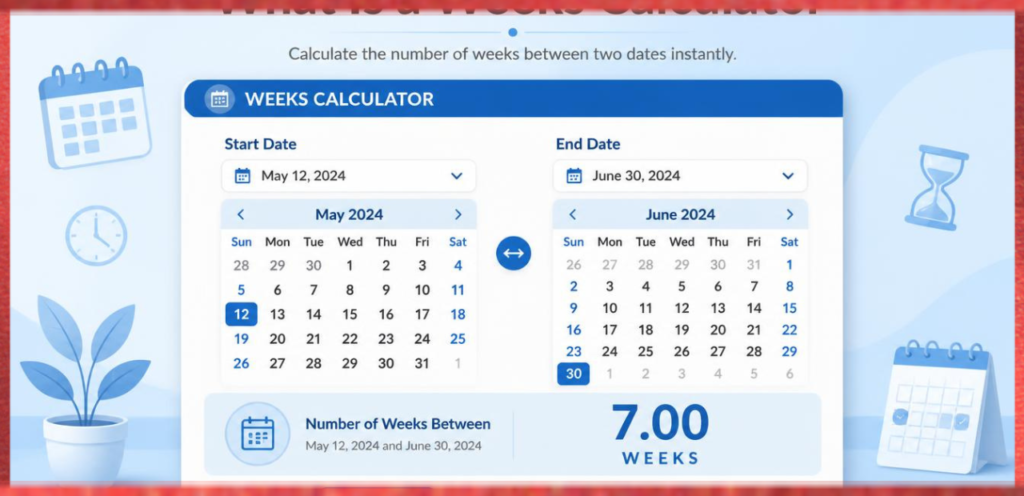
A Weeks Calculator is a simple Date Calculator that finds a new date by adding or subtracting a specified number of weeks from a starting Date.
You provide a Start Date, enter the Number of weeks, and the calculator returns the resulting Target date.
The basic idea is built on one tiny mathematical fact: 1 week = 7 days. So if you want to add six weeks, you’re really adding forty-two days.
For ten weeks, it’s seventy days. Nothing mysterious there, although crossing from one month into another can make the result look a bit magical.
This type of Calendar Calculation can be useful for deadlines, celebrations, project planning, pregnancy milestones, school schedules, vacations, anniversaries, and family events.
A parent welcoming a baby girl might use it to remember a six-week milestone, while someone planning a birthday gathering may want to know exactly what date falls eight weeks after another event.
How to Add Weeks to Date
The easiest way to add weeks to a date is to multiply the number of weeks by seven, then add that many days to the Start Date.
In other words, the calculation follows a simple Weeks-to-days conversion before performing the final Date Calculation.
For example, suppose your starting date is August 16, 2026, and you want to add six weeks. Six weeks multiplied by seven equals forty-two days.
Move forty-two days forward from August 16, and you arrive at September 27, 2026. See, the calendar did not explode after all.
The same approach works for almost any number of weeks. If the question is what is the date 8 weeks from today, calculate eight multiplied by seven, giving fifty-six days, and then add fifty-six days to today’s date. For twelve weeks, the equivalent is eighty-four days.
Weeks Calculator for Future Dates
A Weeks Calculator is especially useful when you need to calculate a future date without manually counting every square on a calendar.
Enter the starting date, choose the desired number of weeks, and the calculator handles the Future Date Calculation.
For example, someone might ask:
- What is the date 6 weeks from today?
- What is the date 8 weeks from today?
- What is the date 10 weeks from today?
- What is the date 12 weeks from today?
Each question uses exactly the same logic. Multiply the chosen number of weeks by seven, then add the resulting number of days to the starting date.
A six-week period is forty-two days, eight weeks is fifty-six days, ten weeks is seventy days, and twelve weeks is eighty-four days.
This can be surprisingly useful for family planning. Imagine a newborn daughter arriving on a Sunday, and the family wants to celebrate her twelve-week milestone on the corresponding Sunday.
Because a complete week contains seven days, adding whole weeks normally keeps the same weekday. That’s a neat little calendar trick people sometimes forget.
Weeks Calculator Add Weeks to Date Using a Calendar
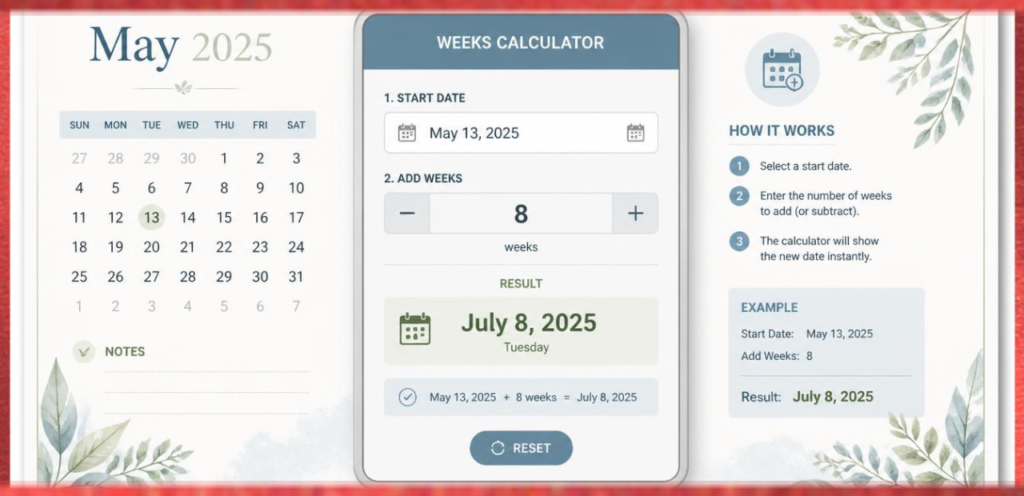
The old-fashioned calendar method still works beautifully when you want to understand the calculation rather than simply receive an answer. Start with the Start Date, then move forward by one week at a time.
If you need to add six weeks, move to the same weekday on the following week six times. For eight weeks, continue the same process eight times.
This is a form of manual date calculation, and it can be useful when you don’t have a calculator nearby.
There is something oddly satisfying about doing this by hand too. A grandparent planning a family visit might circle the starting day, count six little jumps across the calendar, and discover the target date without touching a spreadsheet.
For a newborn celebration, that handwritten circle can even become part of the family memory later on.
Add Weeks Calculator: A Simple Mathematical Method
The mathematical approach is even faster. The formula is simply:
Number of weeks × 7 = Number of days
Then:
Start Date + Number of Days = Target Date
For example:
6 weeks × 7 = 42 days
So, to calculate weeks from a date, you add forty-two days to the specified starting date. The same principle works for any number of weeks, whether you’re calculating 1 week, 6 weeks, 8 weeks, 10 weeks, 12 weeks, or even 5 years’ worth of weekly intervals.
This is basically Addition combined with Multiplication and Date arithmetic. The maths is easy; the calendar part is where people occasionally lose their place.
February, leap years, and months with thirty versus thirty-one days can make manual counting a little annoying.
Common Week-to-Date Calculations
Certain week intervals appear again and again in searches and everyday planning. Knowing their day equivalents makes a Weeks Calculator much easier to understand.
| Number of Weeks | Equivalent Days | Simple Calculation |
|---|---|---|
| 1 week | 7 days | 1 × 7 |
| 6 weeks | 42 days | 6 × 7 |
| 8 weeks | 56 days | 8 × 7 |
| 10 weeks | 70 days | 10 × 7 |
| 12 weeks | 84 days | 12 × 7 |
These numbers can answer questions such as how many days are in six weeks or help you calculate a date several weeks from today. If a special family occasion is exactly ten weeks away, for instance, you already know that the interval represents seventy days.
The useful part is that the relationship never changes. Seven days always make one complete week, so the conversion remains steady even when the calendar month underneath it changes shape a little.
How to Calculate Weeks from a Date
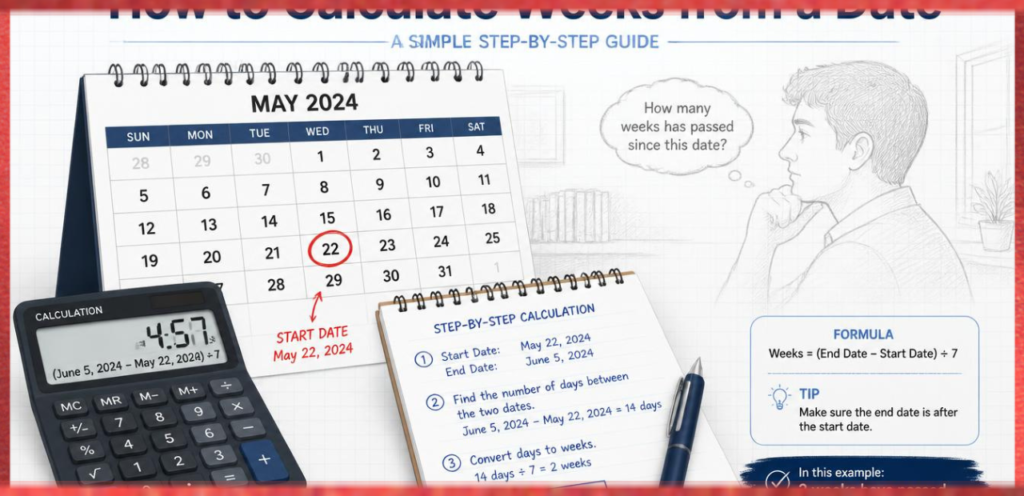
To calculate weeks from a date, first decide whether you are moving forward or backward. A future calculation adds weeks, while a past calculation subtracts them.
Suppose your Start Date is August 16, 2026. Adding eight weeks means moving forward fifty-six days. Asking what was the date 8 weeks ago means moving backward fifty-six days. The arithmetic is the same, but the direction changes.
This distinction is important for a Past Date Calculation. If you are looking for weeks ago from today, don’t accidentally add the days. Subtraction is the little switch that makes the answer travel into the past rather than the future.
Adding Weeks to Today
The phrase weeks from today simply means that today’s date is being used as the starting point. If today is August 16, 2026, then adding one week gives August 23, 2026. Adding six weeks gives September 27, 2026.
Likewise, adding weeks to today can help answer practical questions about upcoming celebrations, work deadlines, trips, or family events. If somebody says, “Let’s meet ten weeks from now,” you can translate that phrase into an exact calendar date instead of keeping the vague promise floating around in your head.
The reverse works too. Weeks ago from today asks you to travel backward from today’s date. It is particularly useful when checking when something happened, especially if the original date wasn’t written down anywhere.
How to Add Weeks Using Excel
A spreadsheet can perform the same Date Calculation automatically. In Microsoft Excel, dates are stored as numerical values behind the scenes, which means adding a number of days to a date is straightforward.
If the Start Date is stored in Cell A1, a simple formula for adding six weeks is:
=A1 + (6 × 7)
That is the same as adding forty-two days. Excel then displays the resulting Date if the cell is formatted as a date.
You can also make the calculation flexible by placing the desired number of weeks in another cell. For example, if A1 contains the starting date and B1 contains the number of weeks, a formula can use the value in B1 to calculate the target date.
This makes the spreadsheet method useful for repeated calculations rather than just one little date question.
The underlying idea is a Date serial value plus a Date offset. Excel does the boring counting for you, which is exactly what spreadsheets are good at.
How to Add Weeks in Google Sheets
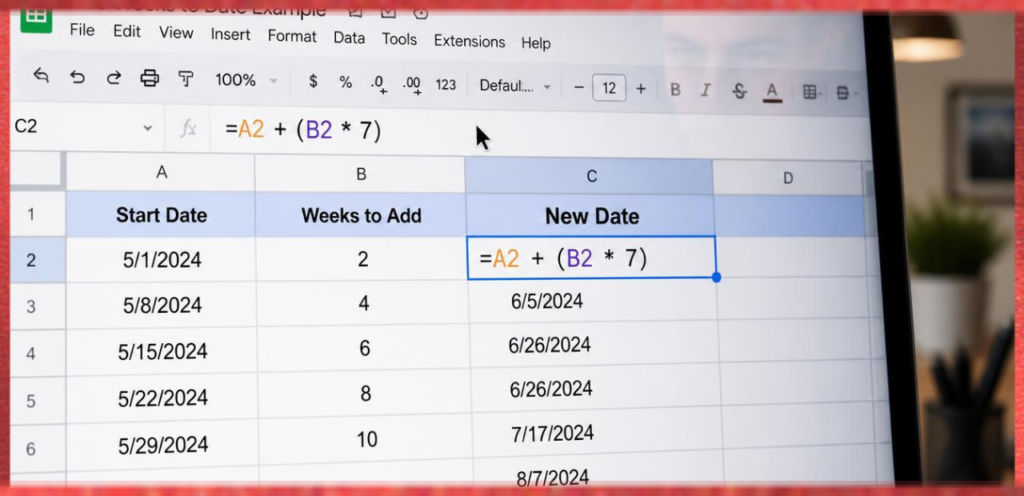
The same concept works in Google Sheets. Enter your Start Date into one cell and your desired number of weeks into another, then create a Google Sheets date formula that converts the weeks into days.
For example, if A1 contains the date and B1 contains the number of weeks, you can calculate the target using:
=A1+(B1*7)
This is a simple Spreadsheet formula for Google Sheets weeks calculation. Change B1 from 6 to 8, and the result automatically changes from six weeks after the start date to eight weeks after it.
This method is handy for event planners, teachers, small businesses, parents, and anyone maintaining a schedule.
Once the formula is there, the spreadsheet quietly handles repeated calendar date calculation without asking you to count anything manually. Very polite of it, honestly.
Weeks Calculator for Past Dates
A Weeks Calculator isn’t only about future dates. It can also function as a past date calculator when you need to discover when something happened several weeks earlier.
For instance, if you want to know what was the date 6 weeks ago, subtract forty-two days from the current date.
For eight weeks ago, subtract fifty-six days. Ten weeks ago means seventy days backward, while twelve weeks ago means eighty-four days backward.
The wording may change, but the principle stays steady:
Past Date = Start Date − (Number of Weeks × 7)
That formula can be useful for reviewing schedules, finding previous milestones, checking old project dates, or remembering how long ago a family celebration occurred.
Why Whole Weeks Are Convenient
Whole-week calculations have one lovely advantage: they usually preserve the weekday. If the starting date is a Sunday and you add six complete weeks, the target date will also be a Sunday.
That makes whole weeks particularly useful for recurring family moments. A baby girl might be welcomed on a Sunday, and the family could plan a small gathering six weeks later on another Sunday. The date changes, but the weekday remains familiar.
It also helps when planning weekly appointments, classes, meetings, or routines. Instead of asking how many individual days separate two dates, you can simply think in complete weekly blocks.
Date Calculation for Baby Milestones and Family Celebrations

A Future Date Calculation isn’t always about business deadlines and spreadsheets. Sometimes it marks something soft and personal.
When a baby girl enters a family, ordinary dates suddenly become little landmarks. The first week can feel like one long sleepy morning.
Six weeks later, everyone may notice how much she has changed. At eight weeks, there may be new expressions, new routines, and a collection of photographs that somehow appeared overnight.
Using a Date Calculator can help families plan a welcome gathering, photo session, family visit, or milestone celebration. The calculator doesn’t create the emotion, of course. It simply puts the emotion on a particular day.
A thoughtful message might say, “Six weeks ago, our little star arrived and changed the rhythm of our whole home.” Another could be lighter: “Eight weeks of tiny yawns, enormous love, and absolutely no respect for bedtime.” Both work because the date gives the feeling something concrete to hold onto.
Making a Date Calculation More Personal
A calculated date can become much more meaningful when you connect it to a person or event. Instead of simply saying, “The target date is September 27,” explain why September 27 matters.
Maybe it’s the day grandparents will visit. Maybe it’s the first family photograph. Maybe it’s the planned celebration of a newborn daughter. A Target Date is only a number until somebody gives it a story.
For a personalized newborn blessing, you might write: “On the day we counted six weeks since your arrival, we realized the calendar had moved quietly, but our hearts had moved miles.” It isn’t mathematically necessary, obviously, but dates are funny little containers for memories.
Understanding Date Arithmetic Without a Calculator
Learning basic date arithmetic is worthwhile even if you normally use an online calculator. When you understand that weeks are simply groups of seven days, a lot of date questions become less intimidating.
You can convert weeks to days, perform the addition or subtraction, and then verify the result on a calendar. This three-step approach is simple enough for children to understand and reliable enough for everyday scheduling.
The main thing to remember is that the number of weeks determines the size of the offset, while the Start Date determines where the calculation begins. Change either one, and the Future Date or Date in the past changes too.
Frequently Asked Questions About a Weeks Calculator
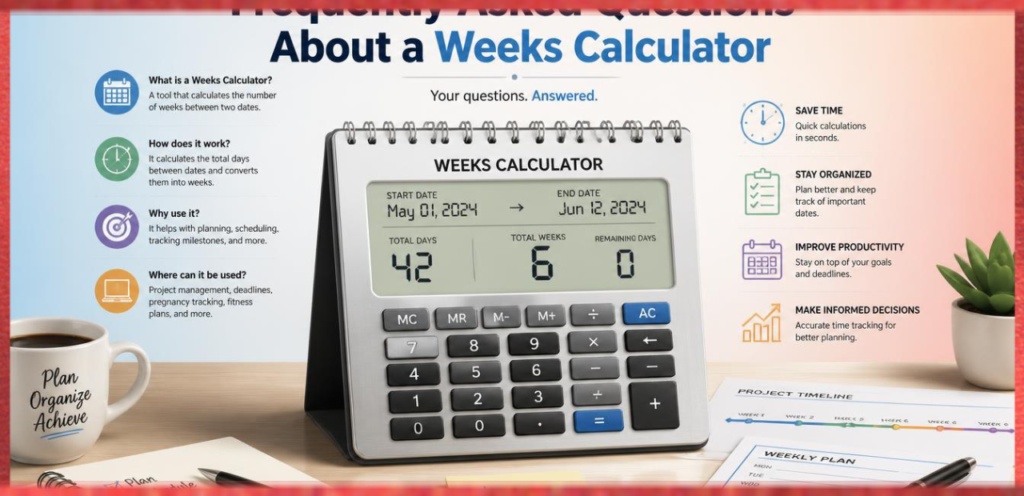
How do I add weeks to a date?
Multiply the desired number of weeks by seven, then add the resulting number of days to the Start Date. A calculator or spreadsheet can do the final calendar arithmetic for you, thankfully.
What is the date 6 weeks from today?
Six weeks equals forty-two days, so add 42 days to today’s date to find the exact Date in the future. The answer depends on the specific day used as today.
What is the date 8 weeks from today?
Eight weeks equals fifty-six days. Add 56 days to today’s date to calculate the exact target date.
What is the date 10 weeks from today?
Ten weeks equals seventy days. A Future Date Calculator can add those 70 days to the current date and return the result.
What is the date 12 weeks from today?
Twelve weeks equals eighty-four days. Add 84 days to the starting date for the corresponding future date.
What was the date 6 weeks ago?
Six weeks ago means 42 days before the starting date. Use subtraction rather than addition for this Past Date Calculation.
What was the date 8 weeks ago?
Eight weeks represents 56 days, so subtract 56 days from the chosen date to find the date eight weeks earlier.
How many days are in six weeks?
There are 42 days in six weeks, because 6 multiplied by 7 equals 42. That’s the entire conversion, no secret calendar wizardry involved.
Can I add weeks in Excel?
Yes. In Microsoft Excel, you can add weeks by converting them to days. With a date in Cell A1, a six-week calculation can use =A1+(6*7).
Can I add weeks in Google Sheets?
Yes. Google Sheets supports ordinary date arithmetic, so a formula such as =A1+(B1*7) can add the number of weeks stored in B1 to the date in A1.
Creative Ways to Use a Weeks Calculator
A Weeks Calculator can quietly become useful in many corners of life. You can use it to calculate school deadlines, vacation dates, recurring events, project milestones, appointment intervals, family visits, and personal goals.
For parents, it can help track meaningful newborn milestones. For teachers, it can help map out a term. For event organizers, it can establish planning checkpoints. For someone writing a heartfelt message, it can transform “a while ago” into an exact memory.
Even a simple phrase such as “Ten weeks ago, you came into our lives” feels different from “A while ago.” The number gives the memory edges.
A Simple Formula to Remember
If you forget everything else in this article, remember this:
Weeks × 7 = Days
Then use:
Start Date + Days = Future Date
or:
Start Date − Days = Past Date
That is the heart of almost every add weeks calculator, date offset calculator, and basic weekly calendar calculation. The tools may look sophisticated, but underneath the screen is some wonderfully ordinary arithmetic.
Frequently Asked Question
add weeks to date
To add weeks to a date, simply multiply the number of weeks by 7 and add those days to the starting date.
72 weeks from today
72 weeks from today is Sunday, December 26, 2027, which is 504 days after August 16, 2026.
add weeks to a date
When you add weeks to a date, each week moves the calendar forward by exactly 7 days, making future-date calculations easy.
add weeks
To add weeks, choose a starting date, multiply the weeks by seven days, and count forward on the calendar.
date plus weeks
Date plus weeks means moving a specific date forward by a chosen number of complete weeks to find the resulting future date.
Read this blog https://naxovater.com/how-many-days-until-may-8/
Final Thoughts on Adding Weeks to a Date
Dates are more than numbers printed in little calendar squares. Sometimes they mark deadlines, sometimes journeys, and sometimes they mark the arrival of someone who makes every ordinary day feel newly invented. A Weeks Calculator simply helps us locate those moments with less fuss.
Whether you need to calculate a future date by weeks, discover weeks ago from today, or use a spreadsheet for repeated date calculations, the method is dependable.
Multiply weeks by seven, apply the resulting day offset, and let the calendar handle the month boundaries.
And when the date belongs to a baby girl, perhaps don’t let the calculation be the whole story. Write the date down beside a photograph.
Add a tiny note about her sleepy yawn or her grandmother’s first cuddle. Years later, the number of weeks may be forgotten, but the reason you counted them probably won’t be.
If you’ve used a weekly date calculation for a family milestone, celebration, deadline, or newborn memory, share how you used it.
Sometimes the most ordinary calendar calculation ends up holding a surprisingly beautiful little story.