

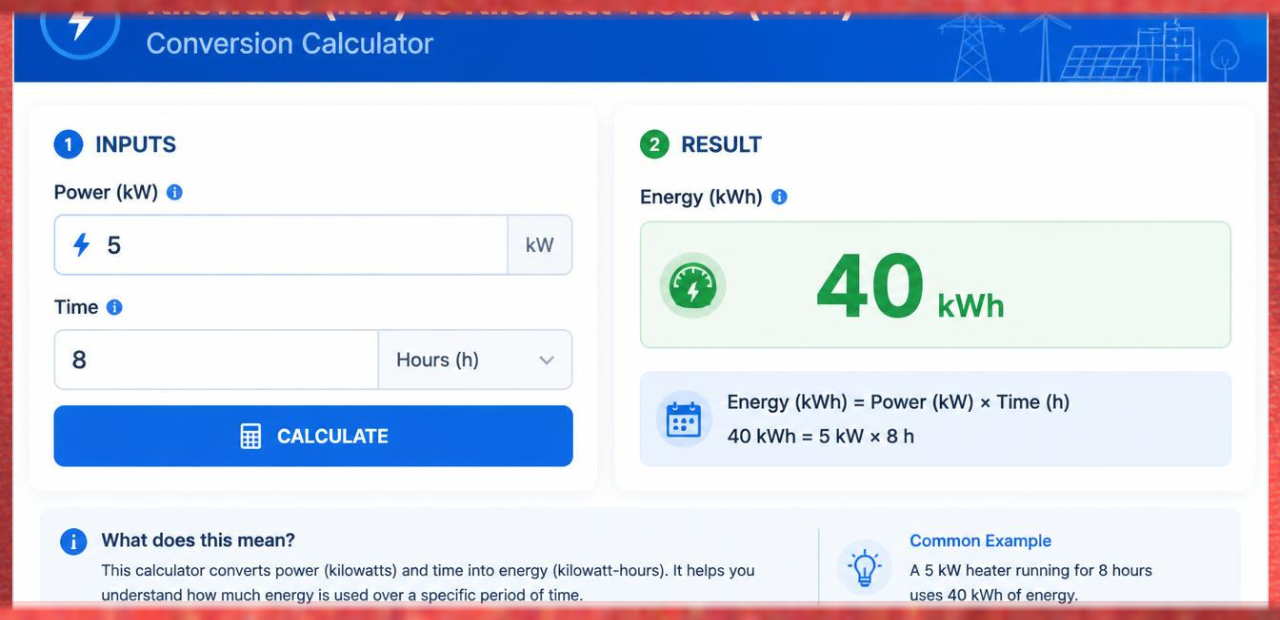
A tiny number on an appliance can tell a surprisingly big story. You see 1 kW, 5 kW, or perhaps 25 kW printed on a machine, and suddenly the question appears: how much electricity will this thing actually use?
It’s a bit like welcoming a new baby girl into a family you know something important has arrived, but the real story unfolds over time.With electricity, that “over time” part is exactly where kWh enters the picture.
A Kilowatt (kW) measures electrical power, while a Kilowatt-hour (kWh) measures electrical energy.
They are connected, but they are not the same thing, and mixing them up is one of those little calculation mistakes that can make an electricity estimate wander off course.
The good news is that kW to kWh conversion is quite simple once you know how power × time works.
This guide explains how to convert kW to kWh, when a kW to kWh calculator is useful, how to calculate electricity usage manually, and how related units such as Watts, Watt-hours (Wh), and Amp-hours (Ah) fit into the wider picture.
What Is a Kilowatt (kW)?
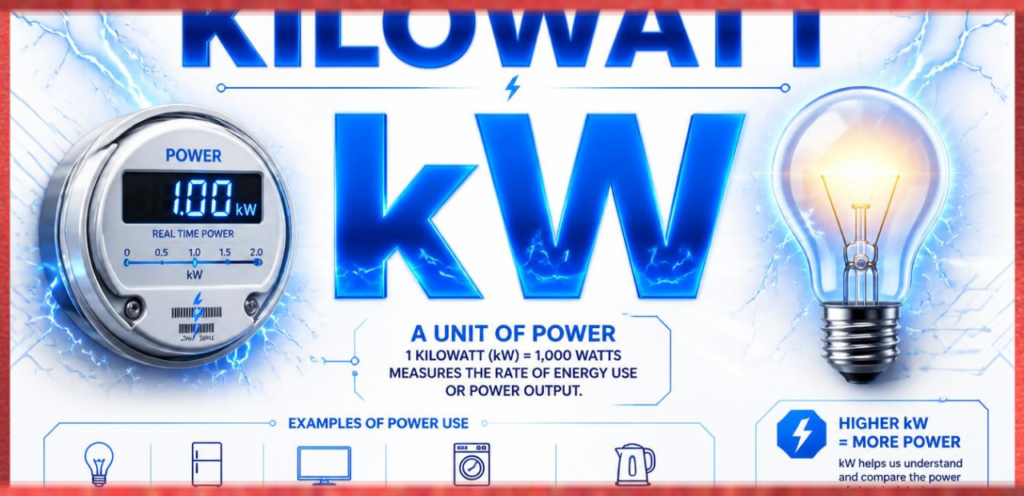
A Kilowatt (kW) is a unit of power measurement. In simple words, power tells us how quickly electrical energy is being used or produced at a particular moment.
One kilowatt equals 1,000 watts, so a device rated at 2 kW has a power rating of 2,000 watts.
Think about an electric heater marked 2 kW. That rating does not automatically mean the heater will use 2 kWh every time you switch it on.
It means the heater uses power at a rate of 2 kilowatts while operating at that rating, which is an important little distinction people sometimes miss.
A Watt (W) is the smaller unit, and kilowatts are simply watts divided by 1,000. So 500 W is 0.5 kW, while 3,500 W is 3.5 kW. Nothing scary hiding there, thankfully.
What Is a Kilowatt-Hour (kWh)?
A Kilowatt-hour (kWh) is a unit of energy measurement. It tells you how much electrical energy is consumed when a certain amount of power operates for a certain amount of Time.
The easiest way to picture it is this: using 1 kW for 1 hour consumes 1 kWh of energy. If that same 1 kW load operates for 5 hours, it consumes 5 kWh.
So, when an electricity bill reports electricity usage in kWh, it is describing accumulated energy consumption rather than simply telling you the power rating of your appliances.
That difference matters quite a lot when you’re trying to estimate costs.
How to Convert kW to kWh
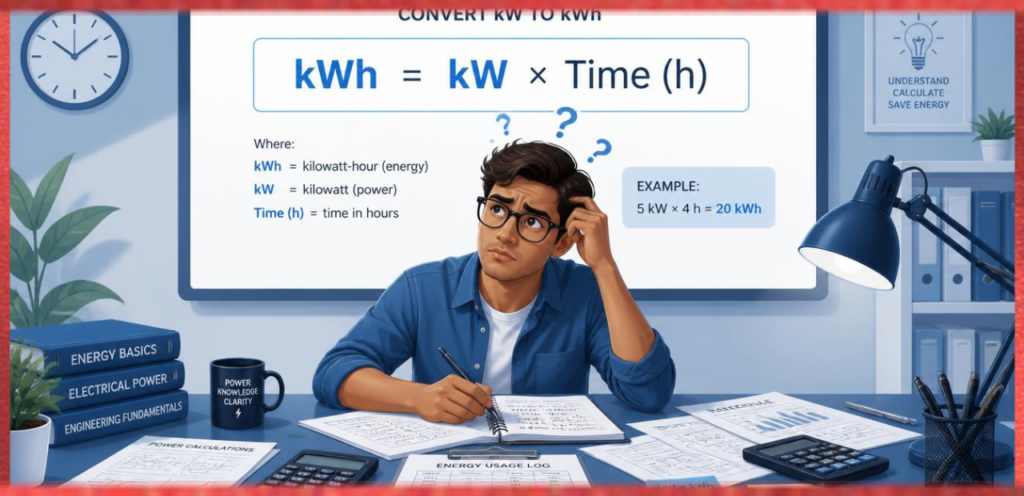
The basic kW to kWh conversion formula is wonderfully short:
Energy = Power × Time
Or, using the standard notation:
E(kWh) = P(kW) × T(hrs)
Here:
- E(kWh) = energy in kilowatt-hours
- P(kW) = power in kilowatts
- T(hrs) = Time in hours
For example, suppose a device has a power rating of 3 kW and operates for 4 hours.
Energy = 3 kW × 4 hours = 12 kWh
So the device consumes 12 kWh during those four hours, assuming it continuously operates at its stated 3 kW power level. Easy enough, though the real-world load can sometimes change instead of staying perfectly steady.
Why Time Matters in a kW to kWh Calculation
You cannot properly calculate kWh from kilowatts and hours without knowing the operating duration. This is the heart of the entire conversion.
Imagine two machines, both rated at 5 kW. One runs for 1 hour, while the other runs for 8 hours. Their power is identical, but their energy consumption is very different.
The first machine uses:
5 kW × 1 hour = 5 kWh
The second uses:
5 kW × 8 hours = 40 kWh
That is why saying “How many kWh is 5 kW?” does not have one universal answer. You need the number of Hours or Hrs involved.
Without time, you’re asking for energy from power with one important ingredient missing.
kW to kWh Conversion Examples
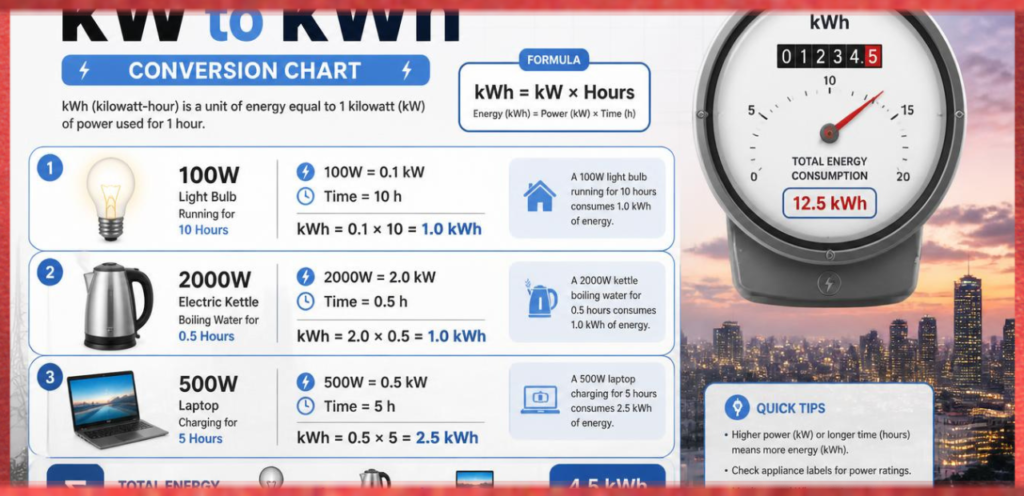
Real numbers make the idea much less mysterious, so here are several common examples. These can also help when checking the result from an electrical energy calculator.
1 kW to kWh
If 1 kW operates for 1 hour:
1 kW × 1 hour = 1 kWh
Therefore, 1 kW for 1 hour equals 1 kWh.
If it operates for 10 hours, the result becomes 10 kWh. Same power, different time, different energy usage.
2 kW to kWh
A 2 kW device operating for 3 hours uses:
2 × 3 = 6 kWh
So, 2 kW for 3 hours equals 6 kWh. If it runs for only half an hour, however, the result is 1 kWh, which is a nice reminder that duration really does the heavy lifting here.
5 kW to kWh
For a 5 kW machine running continuously for 4 hours:
5 × 4 = 20 kWh
Thus, its estimated energy usage calculation is 20 kWh.
10 kW to kWh
A 10 kW electrical load operating for 6 hours consumes:
10 × 6 = 60 kWh
This is a straightforward power to energy conversion, provided the load remains at 10 kW throughout the six-hour period.
25 kW to kWh
Suppose an industrial machine operates at 25 kW for 4 hours:
25 kW × 4 hours = 100 kWh
So 25 kW for 4 hours equals 100 kWh. This example is especially useful because it shows how quickly energy consumption grows when both power and operating time become larger.
50 kW to kWh
If a 50 kW system operates for 8 hours:
50 × 8 = 400 kWh
The result is 400 kWh of energy consumption. Again, this assumes the system continuously operates at its rated 50 kW.
100 kW to kWh
A 100 kW load operating for 2 hours consumes:
100 × 2 = 200 kWh
If it runs for 10 hours, the consumption rises to 1,000 kWh. The number gets large quickly, which is exactly why electricity consumption calculators are handy for larger systems.
kW to kWh Calculator: How It Works
A kW to kWh calculator does not perform some mysterious electrical wizardry behind the screen. It applies the same basic kWh formula:
kWh = kW × hours
You enter the Power in kilowatts, enter the Time in hours, and the calculator produces the estimated Energy in kilowatt-hours.
For instance, enter:
- Power: 7 kW
- Time: 5 hours
The calculator gives:
7 × 5 = 35 kWh
This is useful for appliances, generators, solar systems, motors, heaters, pumps, workshop equipment, and many other electrical loads.
It also saves a bit of mental arithmetic when you’re checking several machines at once, which is honestly nice.
Understanding Power Consumption and Energy Consumption
The phrases power consumption and energy consumption sound almost identical, but they describe different things.
Power consumption refers to the rate at which electricity is being used, commonly expressed in watts or kilowatts. Energy consumption refers to the total amount of electricity used over a period, commonly expressed in Wh or kWh.
A refrigerator might have a particular power requirement while running, but its total daily energy consumption depends on how long and how often its compressor operates.
Real appliances don’t always behave like perfectly obedient mathematical machines, unfortunately.
This distinction is especially important when estimating household electricity costs. Your electricity provider generally bills based on accumulated energy, so kWh energy consumption is usually more relevant to the final bill than the appliance’s kW rating alone.
kW to kWh Conversion Formula in Everyday Life
Let’s take something familiar: an electric heater rated at 2.5 kW.
If you run it for 4 hours:
2.5 × 4 = 10 kWh
If you run the same heater for 2 hours:
2.5 × 2 = 5 kWh
The heater did not magically become more efficient in the second example. It simply operated for less time, so the total energy usage over time was smaller.
This is the basic relationship behind household electricity usage calculation, commercial energy planning, and many industrial estimates. Power tells you the rate; time tells you how long; energy tells you the accumulated result.
What About Watts to kWh?
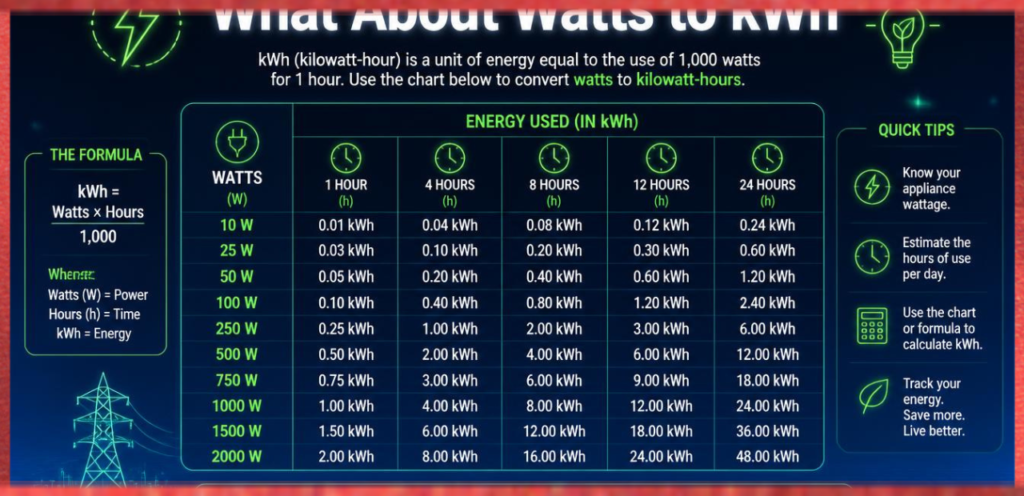
The same principle works when the appliance is rated in watts rather than kilowatts. You just need to convert watts to kilowatts first.
Since:
1 kW = 1,000 W
a 500 W device equals:
500 ÷ 1,000 = 0.5 kW
If it operates for 6 hours:
0.5 × 6 = 3 kWh
Therefore, a 500 W appliance operating continuously for six hours uses 3 kWh.
You can also use a direct calculation:
kWh = Watts × hours ÷ 1,000
This makes watts to kilowatt-hours conversion quick when the power rating is given in W.
kWh to kW Conversion
The reverse calculation is possible too, but it requires the time period.
The kWh to kW conversion formula is:
kW = kWh ÷ hours
For example, if a machine uses 80 kWh over 4 hours:
80 ÷ 4 = 20 kW
Therefore, its average power was 20 kW during that period.
Notice the word “average.” If the machine’s power changed during those four hours, 20 kW represents the average power rather than necessarily its exact instantaneous rating. Thats a small detail, but an important one for accurate electrical calculations.
How Watt-Hours (Wh) Fit Into the Picture
Watt-hours (Wh) are another unit of energy. One kilowatt-hour contains 1,000 watt-hours.
Therefore:
1 kWh = 1,000 Wh
A small electronic device might consume energy measured in Wh, while a home or industrial facility commonly tracks usage in kWh.
For example, 2,500 Wh equals:
2,500 ÷ 1,000 = 2.5 kWh
Understanding Wh alongside kWh makes electrical unit conversion much easier, especially when comparing batteries, appliances, and larger electrical systems.
What Are Amp-Hours (Ah) and Amps?
You may also encounter Amp-hours (Ah) when dealing with batteries. An Ampere (A) measures electric current, while Ah measures electrical charge capacity over time.
However, you cannot generally convert Ah to kWh without knowing the voltage. A simplified relationship is:
Wh = Ah × Voltage
Then:
kWh = Wh ÷ 1,000
For example, a 100 Ah battery at 12 V has an approximate energy rating of:
100 Ah × 12 V = 1,200 Wh
or:
1.2 kWh
Actual usable battery energy can differ because of efficiency, discharge limits, temperature, and other factors. Numbers on a battery label are useful, but reality likes adding its own footnotes.
Common Mistakes When Converting kW to kWh
One of the most common mistakes is assuming that 5 kW automatically equals 5 kWh. It only equals 5 kWh when the power operates for exactly one hour.
Another mistake is forgetting to convert watts into kilowatts. A 2,000 W device is 2 kW, not 2,000 kW. That decimal point can cause a calculation to become very unhappy indeed.
A third mistake is ignoring changing loads. If a device switches between different power levels, simply multiplying its maximum rating by the entire operating time may overestimate actual energy consumption.
Finally, people sometimes confuse power measurement with energy measurement. Remember the simple mental shortcut: kW is the rate, kWh is the accumulated amount.
Why a Conversion Calculator Is Useful
A conversion calculator is particularly helpful when you need to perform repeated electrical calculations.
Instead of calculating every appliance separately, you can quickly enter the power and operating time and compare different scenarios.
It can be useful for:
- Estimating household energy consumption
- Comparing appliance operating costs
- Planning generator capacity
- Estimating solar energy production
- Checking industrial equipment usage
- Calculating electricity consumption
- Comparing different operating schedules
- Understanding monthly energy requirements
A calculator is not a replacement for technical engineering analysis, but for straightforward estimates, it can make the process considerably quicker.
Estimating Electricity Usage in kWh
Suppose a home has three appliances:
- A 1.5 kW heater used for 4 hours
- A 0.2 kW fan used for 8 hours
- A 0.1 kW appliance used for 5 hours
Their estimated energy consumption would be:
Heater: 1.5 × 4 = 6 kWh
Fan: 0.2 × 8 = 1.6 kWh
Other appliance: 0.1 × 5 = 0.5 kWh
Total:
6 + 1.6 + 0.5 = 8.1 kWh
That gives an estimated daily consumption of 8.1 kWh for these three loads. Over a month, simply multiplying by 30 would give 243 kWh if the same usage happened every day.
Real life may differ, of course, because appliances don’t always follow our tidy spreadsheet dreams.
How to Make Your kWh Estimate More Accurate
For better energy consumption estimates, use the actual operating time rather than assuming an appliance runs continuously.
Some devices cycle on and off, while others change their power draw depending on temperature, workload, or settings.
You can also record daily meter readings and compare them with your calculated estimates. This provides a practical reality check between theoretical power consumption calculation and actual electricity usage.
For larger installations, consider whether the equipment operates at full rated power. A motor rated at 20 kW might spend much of its operating time below 20 kW. Using the maximum rating for every hour can therefore produce an inflated estimate.
A Quick Reference Table for kW to kWh
| Power | Operating Time | Energy |
|---|---|---|
| 1 kW | 1 hour | 1 kWh |
| 2 kW | 2 hours | 4 kWh |
| 5 kW | 2 hours | 10 kWh |
| 10 kW | 3 hours | 30 kWh |
| 25 kW | 4 hours | 100 kWh |
| 50 kW | 5 hours | 250 kWh |
| 100 kW | 2 hours | 200 kWh |
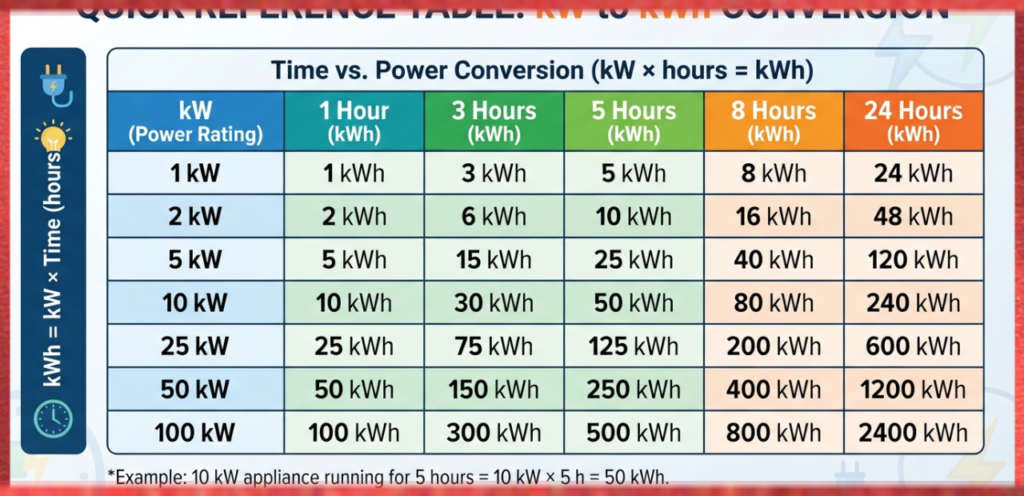
The table gives the simplest possible picture: multiply kW × hours and you get kWh. If the power level changes, though, the calculation needs to account for each period separately.
Frequently Asked Question
kw to kwh conversion
kW to kWh conversion depends on how long the power is used. Multiply kilowatts by the number of hours: kWh = kW × hours.
kw to kwh
To convert kW to kWh, multiply the power in kilowatts by the operating time in hours. For example, 5 kW used for 3 hours equals 15 kWh.
kw to kwh calculator
A kW to kWh calculator quickly determines energy consumption when you enter the power rating and operating time. It is useful for estimating electricity usage for appliances, machines, and equipment.
kilowatt to kilowatt-hour
A kilowatt to kilowatt-hour conversion changes a power measurement into an energy measurement by including time. One kilowatt running for one hour uses 1 kWh of energy.
kw to kwh converter
A kW to kWh converter makes it easy to calculate energy consumption from a device’s power rating and usage duration. Simply multiply the kW value by the number of hours used.
Read this blog https://naxovater.com/what-time-was-it-5-hours-ago/
Final Thoughts on kW to kWh Conversion
The relationship between Kilowatt (kW) and Kilowatt-hour (kWh) is really a story about power, energy, and time working together.
A kilowatt tells you how quickly energy is being used; a kilowatt-hour tells you how much energy has been used across a particular period.
Once you remember E(kWh) = P(kW) × T(hrs), most basic kW to kWh conversion questions become pleasantly straightforward.
Whether you’re trying to calculate energy consumption from power, estimate household electricity usage, compare equipment, or understand an electricity bill, the same little equation keeps coming back.
And perhaps that’s the nicest part of this calculation: there is no need to make it more complicated than it is.
Start with the power in kilowatts, identify the time in hours, multiply them, and your answer is energy in kilowatt-hours. Simple numbers can carry a surprising amount of information, if we let them.
If you are working with a particular appliance, generator, solar system, or machine, use its actual power rating and realistic operating hours for the best estimate.
And if you’ve discovered a particularly useful way of tracking your electricity consumption in kWh, share it sometimes the most practical calculation tips come from ordinary people doing ordinary things, just a little smarter.