

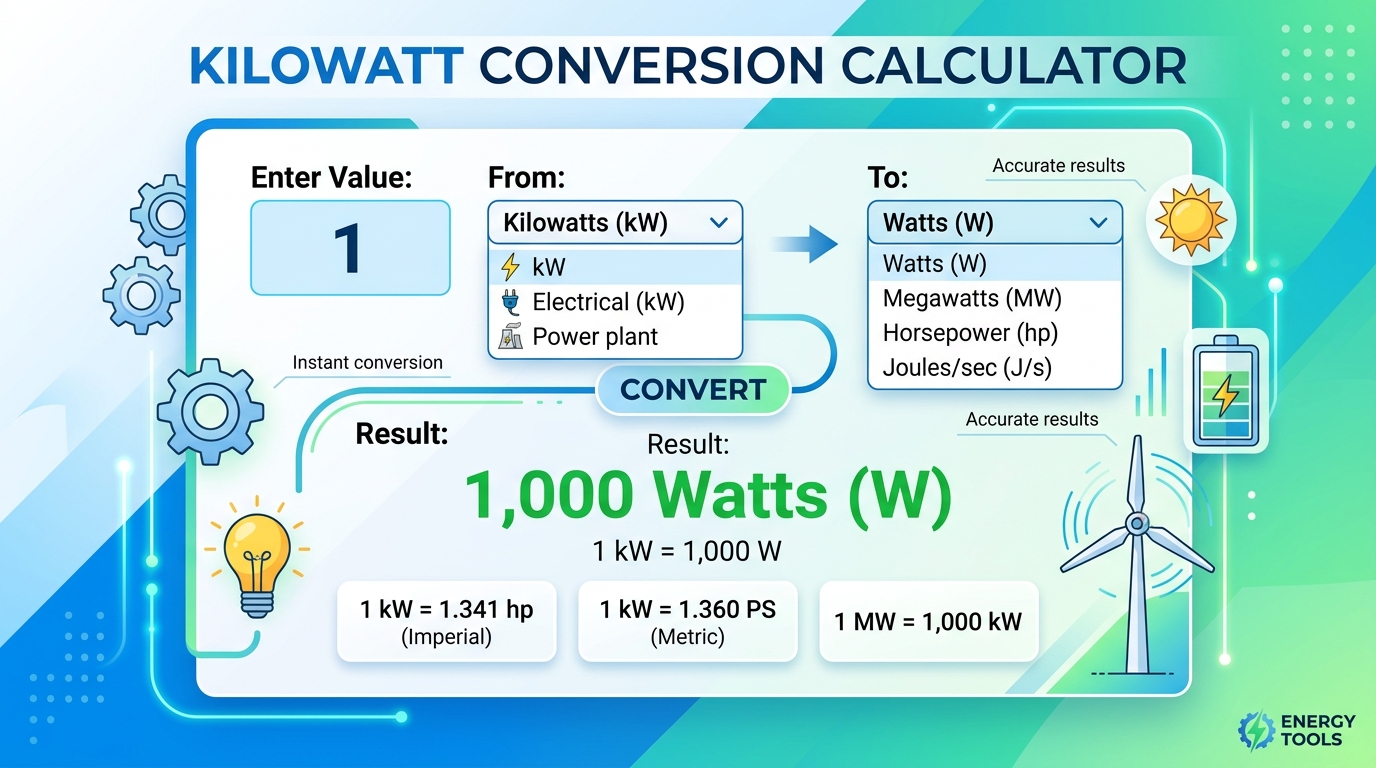
A kilowatt may look like a tiny piece of electrical shorthand, just two letters sitting beside a number, but it quietly tells a big story about how much power something uses or produces.
If you have ever looked at an appliance label, solar panel specification, generator rating, or motor nameplate and wondered what “kW” really means, you are very much not alone.
A kilowatt conversion calculator turns that little mystery into something practical, almost like translating a technical language into everyday numbers.
There is also something strangely satisfying about seeing one value become several others. A 1 kW appliance can become 1,000 watts, 1,000,000 milliwatts, or roughly 1.341 horsepower.
Same power measurement, different measuring language. And once you see how the pieces connect, unit conversion becomes much less intimidating.
| Kilowatts (kW) | Watts (W) |
|---|---|
| 0.1 kW | 100 W |
| 0.5 kW | 500 W |
| 1 kW | 1,000 W |
| 2 kW | 2,000 W |
| 5 kW | 5,000 W |
| 10 kW | 10,000 W |
| 20 kW | 20,000 W |
What Is a Kilowatt?
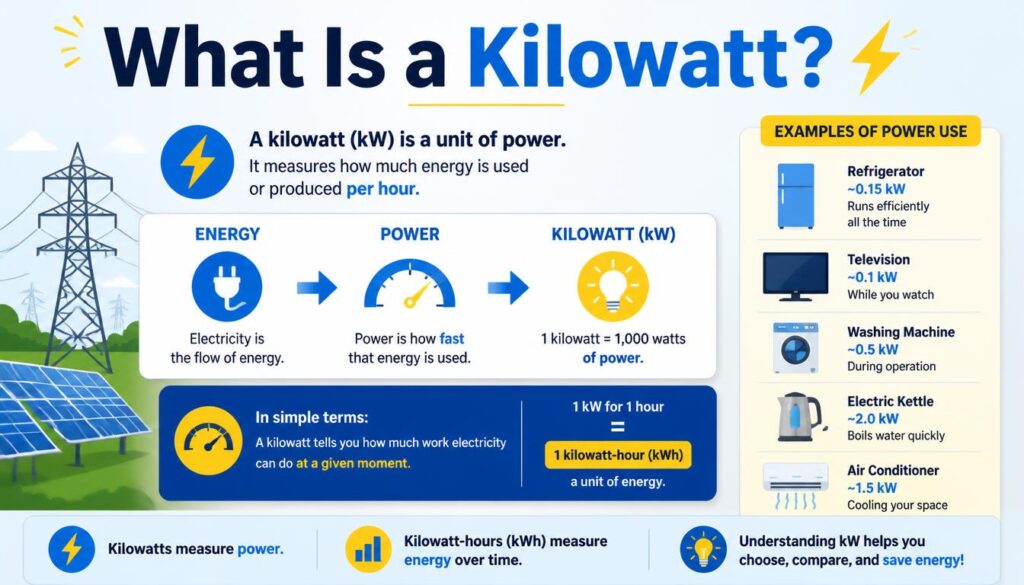
A kilowatt (kW) is a unit used to measure power, especially electrical power. The prefix “kilo” means thousand, so one kilowatt represents one thousand watts. In other words, 1 kW = 1,000 W.
The watt, represented by W, is the standard SI derived unit for power. It describes the rate at which energy is transferred or used.
More technically, one watt equals one joule per second (J/s). Thats the small technical sentence that makes the whole subject click into place.
When you see 5 kW on a generator, for example, it means the generator has a power rating of 5 kilowatts.
That is not the same thing as saying it will consume 5 kWh every hour in every situation, because kilowatt-hour (kWh) measures energy rather than power. Those two terms get mixed up surprisingly often.
How Does a Kilowatt Conversion Calculator Work?
A kilowatt conversion calculator takes a numerical value expressed in kilowatts and applies the appropriate conversion factor to produce an equivalent power in another measurement unit.
The basic idea is delightfully simple:
Kilowatts × conversion factor = result
Suppose you want to convert kW into watts. Since one kilowatt equals 1,000 watts, multiply the kilowatt value by 1,000. For 3 kW:
3 kW × 1,000 = 3,000 W
Nothing mysterious is happening behind the curtain. The calculator is simply applying a known relationship between two measurement units, then presenting the resulting numerical value.
Kilowatt Conversion Calculator: Common Power Conversions
Different industries use different units, so a single power value can have several useful forms. A power converter makes these comparisons easier when you’re dealing with specifications from different countries, manufacturers, or technical documents.
Here are some common equivalents for 1 kW:
| Power Unit | Equivalent to 1 kW |
|---|---|
| Watt (W) | 1,000 W |
| Microwatt (µW) | 1,000,000,000 µW |
| Milliwatt (mW) | 1,000,000 mW |
| Megawatt (MW) | 0.001 MW |
| Horsepower (hp) | ≈ 1.341022 hp |
| BTU per hour (Btu/h) | ≈ 3,412 Btu/h |
| Kilocalorie per hour (kcal/h) | ≈ 860.420815 kcal/h |
| Joule per second (J/s) | 1,000 J/s |
These relationships are useful for a quick power conversion table, although the exact horsepower or BTU/h figure can depend on the convention being used.
So, if you’re working with engineering specifications, it pays to check which definition the source uses.
Kilowatt to Watt Conversion
The most common kilowatt to watt calculation is almost embarrassingly easy once you know the rule. Multiply the kilowatt value by 1,000.
For example:
2 kW = 2 × 1,000 = 2,000 W
7.5 kW = 7.5 × 1,000 = 7,500 W
0.25 kW = 0.25 × 1,000 = 250 W
So, when someone asks, “how many watts in a kilowatt?” the answer is 1,000 watts. Likewise, 1 kW equals 1,000 W.
The reverse calculation works too. To convert watts to kilowatts, divide by 1,000. A 4,000 W heater is therefore 4 kW. Simple numbers sometimes deserve simple treatment, no need to dress them up in a laboratory coat.
Kilowatt to Megawatt Conversion
A megawatt (MW) is much larger than a kilowatt. One megawatt equals 1,000 kilowatts.
Therefore:
1 kW = 0.001 MW
To convert kilowatts to megawatts, divide the kilowatt value by 1,000. A 500 kW installation is:
500 ÷ 1,000 = 0.5 MW
This conversion becomes especially handy with large solar farms, power stations, industrial equipment, and utility infrastructure.
A number that looks enormous in kilowatts can suddenly look more manageable when expressed in megawatts.
Kilowatt to Milliwatt and Microwatt
The prefixes can feel like a tiny linguistic maze at first, but they follow the logic of the metric system.
A milliwatt is one-thousandth of a watt, while a microwatt is one-millionth of a watt. Since a kilowatt already contains 1,000 watts, the resulting numbers grow very quickly when converting downward.
For kilowatt to milliwatt:
1 kW = 1,000,000 mW
For kilowatt to microwatt:
1 kW = 1,000,000,000 µW
That means one kilowatt is equal to one billion microwatts. A little unit prefix can create a very big number, which is why writing the conversion carefully matters.
Kilowatt to Horsepower
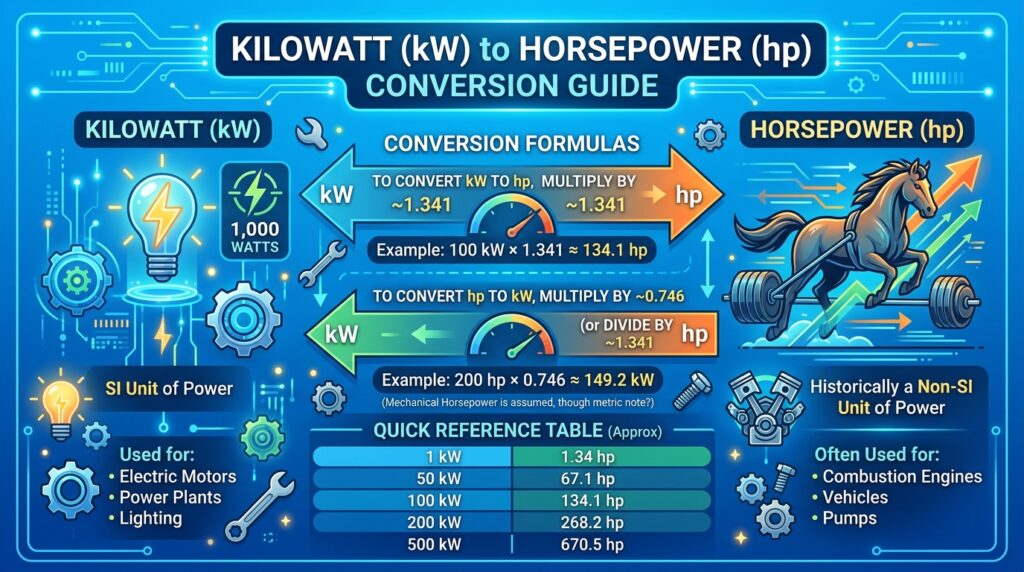
Horsepower belongs to a different measurement tradition and is commonly associated with engines, motors, vehicles, and mechanical equipment. A commonly used conversion is:
1 kW ≈ 1.341022 hp
Therefore, to perform a kilowatt to horsepower conversion, multiply the kilowatt value by approximately 1.341022.
For example:
10 kW × 1.341022 ≈ 13.41022 hp
You may encounter slightly different horsepower conversions because horsepower has more than one historical definition.
Mechanical horsepower, metric horsepower, and electrical horsepower are not perfectly identical, so technical work should use the convention specified by the relevant standard.
Kilowatt to BTU per Hour
If you’re comparing metric units with US customary units or Imperial units, BTU per hour can appear in heating, cooling, and HVAC specifications.
A commonly used approximation is:
1 kW ≈ 3,412 Btu/h
So a 5 kW heater would be approximately:
5 × 3,412 = 17,060 Btu/h
This is often useful when comparing heating or cooling equipment whose ratings are presented in different systems.
A kilowatt to BTU conversion can make two seemingly unrelated specifications much easier to compare.
Kilowatt to Kilocalorie per Hour
Another less common but useful conversion is from kilowatts to kilocalories per hour (kcal/h).
The relationship is approximately:
1 kW ≈ 860.420815 kcal/h
So, for 2 kW:
2 × 860.420815 ≈ 1,720.84163 kcal/h
This type of conversion may appear in thermal engineering or heating-related calculations. It isn’t the conversion most people need every Tuesday morning, admittedly, but when the right project comes along, it can save quite a bit of head scratching.
Why Is a Watt a Power Unit?
The watt is named after James Watt, whose work became strongly associated with steam engines and mechanical power.
Today, however, the watt isn’t limited to engines. It is a fundamental unit for describing power across electrical, mechanical, thermal, and other systems.
Power can be understood as the rate of energy consumption or transfer. One watt means one joule of energy transferred per second:
1 W = 1 J/s
Consequently:
1 kW = 1,000 J/s
This relationship explains why kilowatts and energy are connected, while still being different concepts.
Power tells you how quickly energy is being transferred; energy tells you how much has been transferred or consumed.
Kilowatts vs. Kilowatt-Hours
This is probably the most important distinction to understand when using an electrical calculator.
A kilowatt measures power. A kilowatt-hour measures energy.
Imagine a 2 kW heater running continuously for 3 hours. Its energy use would be:
2 kW × 3 hours = 6 kWh
The heater’s power rating remains 2 kW. The 6 kWh represents the energy consumed during those three hours.
This difference matters when discussing electricity bills, energy consumption, appliances, solar systems, and batteries.
Saying an appliance “uses 2 kW per hour” is common in casual conversation, but technically it is better to say that the appliance has a 2 kW power demand and consumes 2 kWh when operated for one hour.
Kilowatt Conversion Calculator and Electrical Power
Electrical systems introduce additional units such as ampere (A), volt-ampere (VA), and kilovolt-ampere (kVA).
These shouldn’t be casually treated as direct substitutes for kilowatts because they describe related but different electrical quantities.
An ampere, or amp, measures electrical current. Volt-amperes describe apparent power, while kilowatts describe real power. In AC electrical systems, the relationship between kW and kVA can depend on the power factor.
For an idealized system with a power factor of 1:
1 kVA = 1 kW
But when the power factor is less than 1, kVA and kW will not have the same numerical value. Thats why a request to “convert kW to kVA” may require additional information rather than one universal conversion factor.
Kilowatt Conversion Formula
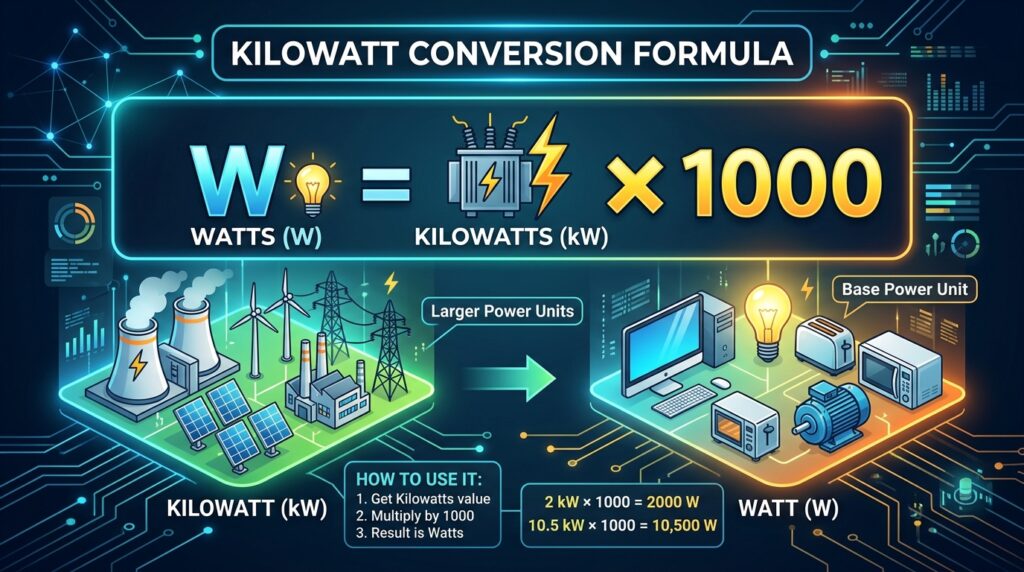
The general approach to power unit conversion is straightforward:
Converted value = original value × conversion factor
For example, to calculate watts from kilowatts:
W = kW × 1,000
For megawatts:
MW = kW × 0.001
For horsepower using the common approximation:
hp ≈ kW × 1.341022
For BTU per hour:
Btu/h ≈ kW × 3,412
The important thing is to identify the desired unit before choosing the conversion factor. Otherwise, even perfect arithmetic can produce the wrong answer, which is a rather sneaky kind of mistake.
A Quick kW Conversion Chart
A compact kW conversion chart can be useful when you repeatedly work with electrical or mechanical specifications.
| Kilowatts | Watts | Megawatts | Horsepower* |
| 0.5 kW | 500 W | 0.0005 MW | ≈ 0.671 hp |
| 1 kW | 1,000 W | 0.001 MW | ≈ 1.341 hp |
| 2 kW | 2,000 W | 0.002 MW | ≈ 2.682 hp |
| 5 kW | 5,000 W | 0.005 MW | ≈ 6.705 hp |
| 10 kW | 10,000 W | 0.01 MW | ≈ 13.410 hp |
| 50 kW | 50,000 W | 0.05 MW | ≈ 67.051 hp |
| 100 kW | 100,000 W | 0.1 MW | ≈ 134.102 hp |
*Horsepower values use the common approximation of 1 kW ≈ 1.341022 hp.
Kilowatt Conversion Calculator: Metric and Imperial Units
The SI system and metric system organize measurements around standardized relationships, making conversions between watts, kilowatts, milliwatts, and megawatts particularly convenient.
By comparison, US customary units and Imperial units include measurements such as horsepower and BTU-based quantities.
These systems developed through different historical paths, so their relationships with SI units often require specific conversion factors.
The National Institute of Standards and Technology (NIST) is an important reference for measurement standards and unit relationships in the United States.
For professional calculations, standards-based references are preferable to relying on a random conversion figure copied from somewhere online.
Common Mistakes When Converting Kilowatts
One common mistake is confusing kW with kWh. As discussed earlier, kW measures power while kWh measures energy. They live in the same neighborhood, but they are not the same house.
Another mistake is moving decimal places in the wrong direction. Since kilo means thousand, converting kW to W makes the numerical value larger by a factor of 1,000. Converting W to kW makes it smaller by a factor of 1,000.
People also sometimes assume that kW can always be converted directly into amps. It can’t, not without knowing factors such as voltage, phase configuration, and sometimes power factor. Electrical calculations have a few more moving pieces than ordinary metric conversion.
When Should You Use a Kilowatt Converter?
A kilowatt converter can be useful for many everyday and professional situations. You might use one when comparing appliances, checking generator capacity, reviewing solar panel output, estimating motor performance, or translating an overseas equipment specification.
It can also help students understand SI units, technicians compare ratings, and homeowners make sense of electricity-related terminology. Sometimes the value isn’t the arithmetic itself; it’s simply getting all the numbers into one consistent language.
For repeated work, an electrical power calculator, power unit converter, or general unit conversion calculator can reduce repetitive calculations. Just remember that the calculator is only as trustworthy as the units and assumptions you give it.
Practical Examples of Kilowatt Conversion
Consider a 3.5 kW electric heater.
To convert it to watts:
3.5 × 1,000 = 3,500 W
To convert it to horsepower:
3.5 × 1.341022 ≈ 4.694 hp
To convert it to BTU per hour:
3.5 × 3,412 ≈ 11,942 Btu/h
Now imagine a 75 kW industrial motor. In watts, that is 75,000 W, while in megawatts it is 0.075 MW.
The same physical power rating suddenly has three different numerical faces. Thats the whole usefulness of conversion: the quantity stays conceptually the same while the unit changes.
How to Choose the Right Conversion Factor
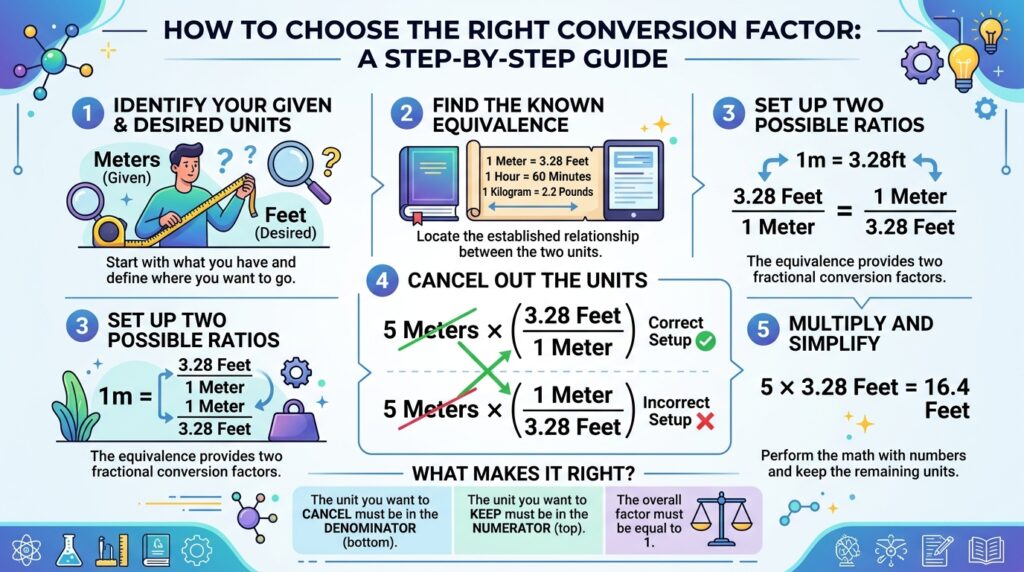
Start by identifying the unit you have and the unit you want. If the original measurement is 8 kW and the desired unit is watts, the conversion factor is 1,000.
Then multiply the original numerical value by that factor. Finally, check whether the answer makes sense.
If you converted 8 kW to watts and somehow got 0.008 W, your decimal point has wandered off somewhere.
For unusual units such as horsepower or Btu/h, verify which convention is being used. A reputable reference, calculator, or standards organization can help avoid subtle differences between definitions.
Kilowatt Conversion Calculator FAQs
How many watts is 1 kW?
1 kW equals 1,000 W. The prefix kilo means thousand, so one kilowatt is exactly one thousand watts.
What is 1 kW equal to in horsepower?
Using the common mechanical horsepower conversion, 1 kW ≈ 1.341022 hp. Different horsepower definitions can produce slightly different values.
How many BTU are in 1 kW?
A commonly used conversion is 1 kW ≈ 3,412 Btu/h. The exact figure can vary slightly depending on the BTU convention.
How many joules per second is 1 kW?
Because one watt equals one joule per second, 1 kW = 1,000 J/s.
Is kW the same as kWh?
No. kW measures power, while kWh measures energy. A 2 kW device operating for 3 hours consumes 6 kWh of energy.
Can you convert kW to amps?
Yes, but not from kW alone in most electrical systems. Voltage, phase information, and sometimes power factor are needed to calculate current in amperes (A).
Can you convert kW to kVA?
It depends on the electrical system’s power factor. For power factor 1, kW and kVA are numerically equal, but they differ when the power factor is below 1.
What does the kilo prefix mean?
Kilo means thousand. Therefore, one kilowatt is one thousand watts, while one megawatt is one thousand kilowatts.
Frequently Asked Question
kw to unit
“kW to unit” usually refers to converting electrical power in kilowatts into electricity units, commonly measured as kilowatt-hours (kWh).
kw to unit converter
A kW to unit converter helps estimate electricity consumption by combining the power rating in kW with the amount of time the appliance operates.
2kw in units
A 2 kW appliance running for 1 hour consumes 2 units of electricity, because 1 unit is generally equal to 1 kWh.
kw into unit
To convert kW into electricity units, you need the operating time: kW × hours = kWh (units).
1kw to unit
A 1 kW appliance running continuously for 1 hour uses 1 unit of electricity, or 1 kWh.
Read this blog https://naxovater.com/3-months-from-today/
A Few Final Words About Power Conversion
Numbers have a funny way of becoming friendlier once their relationships are visible. A kilowatt isn’t just a technical abbreviation printed on an appliance label.
It belongs to a larger measurement system connecting watts, joules, horsepower, BTU per hour, megawatts, and several other units.
The central relationship is beautifully uncomplicated: 1 kW = 1,000 W = 1,000 J/s. From there, the rest of the kilowatt conversion process is largely a matter of choosing the right conversion factor and keeping power separate from energy.
Whether you’re checking a home appliance, comparing a generator, studying electrical engineering, or simply wondering how many watts are in a kilowatt, a reliable kilowatt conversion calculator can turn the calculation into a quick, readable result.
And when the numbers start getting crowded, a good conversion chart is still a lovely little thing to have nearby.
In the end, unit conversion isn’t really about moving numbers around. It’s about making different measurement systems understandable to one another.
A kilowatt speaks one dialect, horsepower another, and Btu/h yet another, but the underlying power can still be compared. Once that clicks, the whole subject feels less like a wall of symbols and more like a conversation between familiar measurements.