

You might’ve searched how to convert milligrams to milliliters because a medicine label looked confusing, a recipe mentioned unfamiliar numbers, or maybe a chemistry assignment decided to become dramatic for no reason at all.
Funny enough, Milligrams (mg) and Milliliters (mL) seem like cousins, but they measure completely different things. That tiny difference catches people off guard more often than you’d think.
Here’s the thing though there isn’t one magical number that converts mg to mL every single time. The missing piece is Density. Once you understand that, the whole process becomes surprisingly simple. And yeah, it almost feels like the numbers suddenly start speaking the same language.
In this guide, we’ll break everything down with practical examples from medicine, cooking, baking, and chemistry. You’ll also learn the conversion Formula, common mistakes to avoid, and easy reference tables you can actually use.
| Milligrams (mg) | Density (g/mL) | Formula | Milliliters (mL) |
|---|---|---|---|
| 500 mg | 0.7 | 500 ÷ (1,000 × 0.7) | 0.7143 mL |
| 250 mg | 1.0 | 250 ÷ (1,000 × 1.0) | 0.25 mL |
| 100 mg | 1.0 | 100 ÷ (1,000 × 1.0) | 0.10 mL |
| 1,000 mg | 1.0 | 1,000 ÷ (1,000 × 1.0) | 1.00 mL |
| Conversion Formula | Formula | Result | Note |
| mg → mL | mL = mg ÷ (1,000 × density in g/mL) | Calculates volume | Use when density is in g/mL |
| mg → mL | mL = mg ÷ density (mg/mL) | Calculates volume | Use when density is already in mg/mL |
Understanding the Difference Between Milligrams and Milliliters
Before attempting any Unit conversion, it’s important to know what each unit measures.
- Milligrams (mg) measure Mass or the amount of matter in a substance.
- Milliliters (mL) measure Volume, meaning how much space a liquid occupies.
Both belong to the Metric system and are recognized as SI units for scientific and everyday Measurement.
For example:
- 1 Gram (g) = 1,000 Milligrams (mg)
- 1 Liter (L) = 1,000 Milliliters (mL)
- 1 Cubic centimeter (cc) = 1 Milliliter (mL)
Many people confuse Weight with Mass, although they’re technically different. Mass stays the same whether you’re standing on Earth or the Moon, while Weight changes because of Force caused by gravity. That’s kinda neat when you stop and think about it.
Why You Cannot Directly Convert Milligrams to Milliliters
This is probably the biggest misunderstanding.
Since Milligrams measure Mass and Milliliters measure Volume, they cannot be converted directly without knowing the Material density or Liquid density.
Imagine these examples:
| Substance | 500 mg Equals Different mL Because… |
|---|---|
| Water | Density is about 1 g/mL |
| Milk | Slightly denser than water |
| Cooking oil | Less dense than water |
| Liquid suspension | Depends on formulation |
| Powdered medicine | Depends on concentration |
Every substance has its own Ingredient density, making every Weight-to-volume conversion unique.
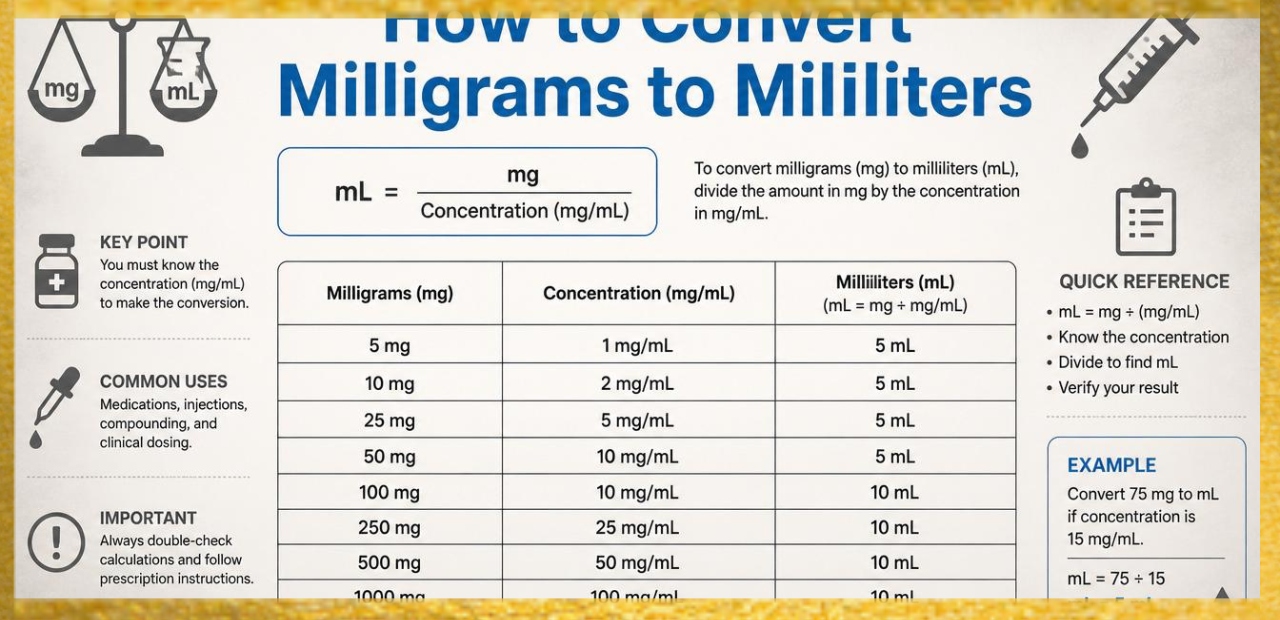
The Milligrams to Milliliters Formula
The standard Conversion formula is:
mL = mg ÷ (Density × 1000)
Where:
- mg = amount in milligrams
- Density = grams per milliliter (g/mL)
- 1000 converts Milligrams into Grams
Another version often used in medicine is:
mL = mg ÷ concentration (mg/mL)
This is especially useful when medications list strength as Milligrams per milliliter (mg/mL).Understanding which formula applies makes the entire milligrams to milliliters formula much easier.
Step-by-Step: How to Convert Milligrams to Milliliters
Let’s simplify the process.
Step 1: Identify the Mass
Determine the number of Milligrams (mg).
Example:
750 mg
Step 2: Find the Density
Look up the Grams per milliliter (g/mL) value or medication concentration.
Example:
Density = 1 g/mL
Step 3: Apply the Formula
mL = 750 ÷ (1 × 1000)
Answer:
0.75 mL
Simple… once you know the missing density value, anyway.
Convert mg to mL Using Density
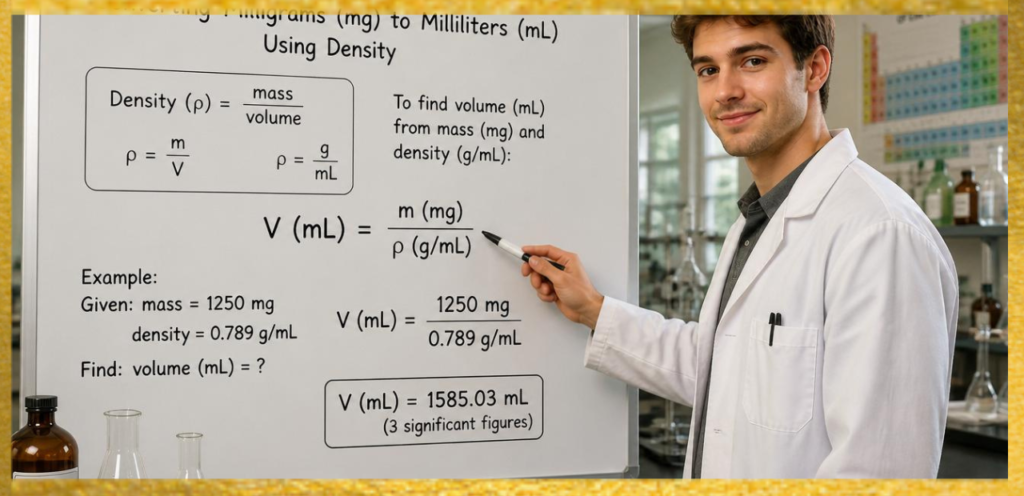
When people search convert mg to mL using density, this is exactly what they mean.
Example with Water
Density:
1 g/mL
250 mg
250 ÷ 1000 = 0.25 mL
Example with Cooking oil
Approximate density:
0.92 g/mL
500 mg
500 ÷ (0.92 × 1000)
≈ 0.54 mL
Notice how identical masses produce different volumes.
That’s why Density-based unit conversion is essential.
Common Density Values
Here’s a handy reference.
| Material | Approximate Density (g/mL) |
|---|---|
| Water | 1.00 |
| Milk | 1.03 |
| Cooking oil | 0.92 |
| All-purpose flour | 0.53–0.59 |
| Granulated sugar | 0.85 |
These values help with Cooking ingredients, Baking ingredients, laboratory work, and general Volume-to-weight conversion.
Milligrams to Milliliters Conversion Table
This basic Conversion table assumes a density of 1 g/mL.
| Milligrams (mg) | Milliliters (mL) |
|---|---|
| 100 mg | 0.10 mL |
| 250 mg | 0.25 mL |
| 500 mg | 0.50 mL |
| 750 mg | 0.75 mL |
| 1000 mg | 1.00 mL |
| 1500 mg | 1.50 mL |
| 2000 mg | 2.00 mL |
| 5000 mg | 5.00 mL |
Remember, these values apply only when density equals 1 g/mL.
How Many mL Is 500 mg?
This question gets searched thousands of times.
The answer depends entirely on density.
Examples:
- Water → 0.5 mL
- Oil → approximately 0.54 mL
- Medication → depends on labeled concentration
So there isn’t one universal answer.
How Many Milliliters Is 1000 mg?
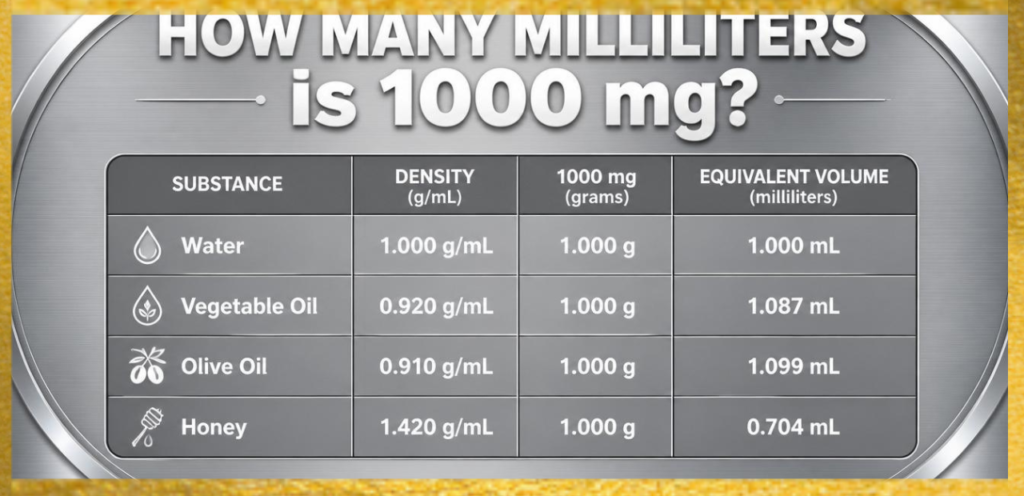
Again, the answer depends on the substance.
If density equals 1 g/mL:
1000 mg = 1 mL
If density differs, the volume changes.
Always check the Material density or medicine label first.
MG to mL Conversion for Medication
This is where accuracy becomes incredibly important.
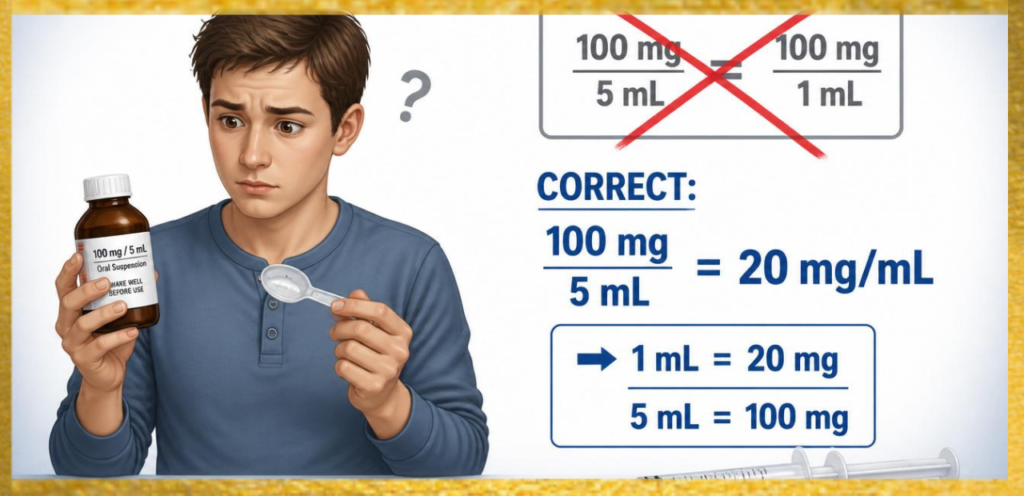
Many prescriptions list concentrations like:
- 125 mg/5 mL
- 250 mg/5 mL
- 500 mg/10 mL
Example:
Prescription:
250 mg
Bottle:
125 mg per 5 mL
Calculation:
250 ÷125 ×5
Answer:
10 mL
Never guess medicine amounts. Even tiny mistakes can affect Drug dosage.When unsure, ask Doctors or Pharmacists.
Understanding Milligrams per Milliliter (mg/mL)
Milligrams per milliliter (mg/mL) describes concentration.
Example:
100 mg/mL
means
Every 1 mL contains 100 mg.
Need 300 mg?
300 ÷100 = 3 mL
This shortcut is used constantly in Medication, hospitals, pharmacies, and laboratories.
Converting Grams per Milliliter to Milligrams per Milliliter
People also search:
convert grams per milliliter to mg per mL
Fortunately, it’s easy.
Multiply by 1000.
Example:
1 g/mL
=
1000 mg/mL
0.5 g/mL
=
500 mg/mL
Cooking Ingredient Conversion by Density
Cooking isn’t always about cups and spoons.Professional recipes sometimes require Mass measurement rather than Volume measurement.
Consider these ingredients:
- All-purpose flour
- Granulated sugar
- Cooking oil
- Milk
- Water
Because each has different densities, measuring ingredients accurately improves consistency.
Bakers know this well. A cake can rise beautifully one day and sulk into a pancake the next if measurements wander too much. Bit dramatic? Maybe, but flour has feelings too… alright, maybe not.
Baking Measurements and Kitchen Accuracy
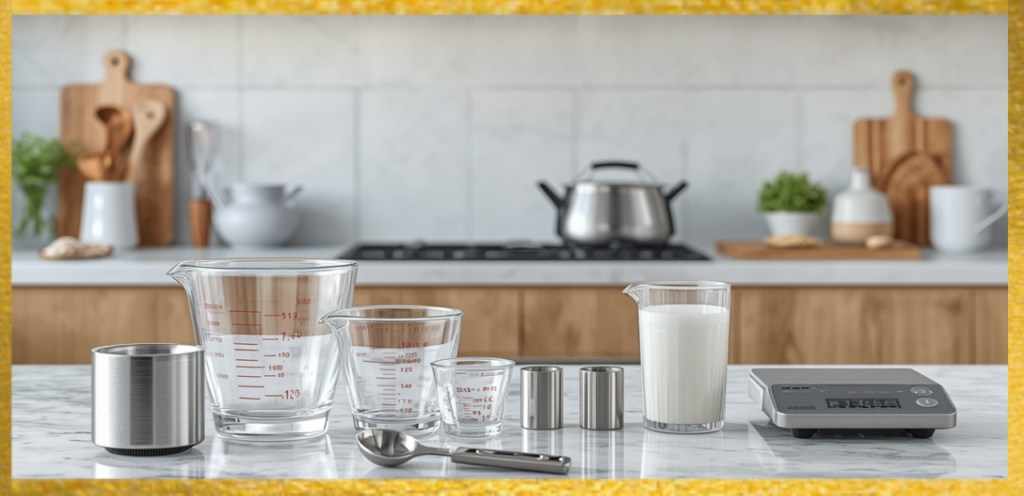
Many home cooks rely on cups.
Professionals often use:
- Digital scales
- Kitchen scales
- Measuring cylinders
- Laboratory-style measuring cups
A good digital scale improves Accurate measurements, especially when following international recipes.
Chemistry Mass to Volume Conversion
In Chemistry, Mass-volume stoichiometry frequently requires converting between mass and volume.
Scientists work with:
- Chemicals
- Aqueous chemicals
- Powdered chemicals
- Solutions
- Suspensions
Understanding Density formula helps predict:
- Chemical reactions
- Yield of reaction
- Laboratory concentrations
Without density, calculations quickly become inaccurate.
Scientific Measurement and the Metric System
The Metric system makes calculations much easier than older measurement systems.
Common units include:
| Mass | Volume |
|---|---|
| Milligram | Milliliter |
| Gram | Liter |
| Kilogram | Cubic centimeter |
Other units sometimes encountered include:
- Grain
- Pound
- Ounce
- Fluid ounce
- Cup
- Pint
- Quart
- Gallon
- Tablespoon
- Teaspoon
Converting among these often requires an additional Conversion factor.
Why Density Matters So Much
The Density equation is:
Density = Mass ÷ Volume
Rearranging gives:
Volume = Mass ÷ Density
Almost every Weight to volume conversion relies on this relationship.
Different materials simply occupy different amounts of space.
Using an MG to mL Calculator
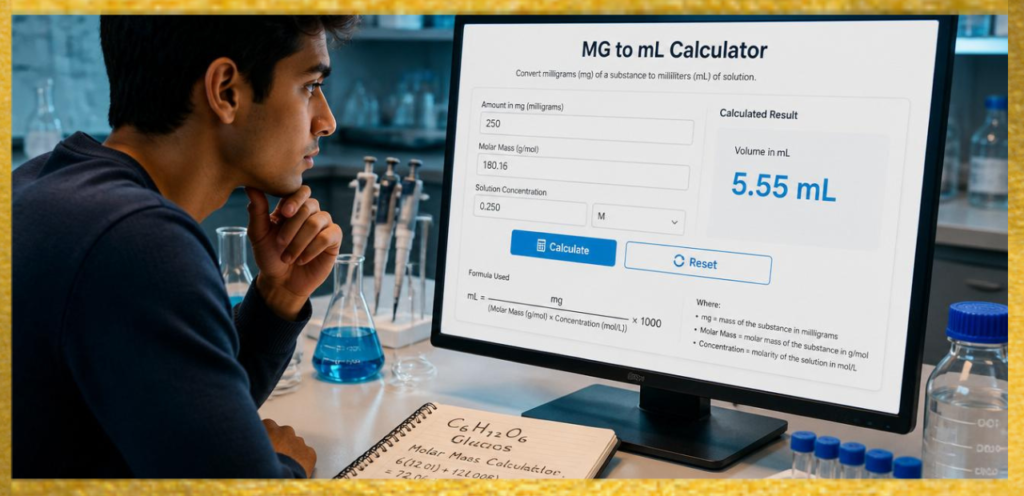
A Conversion calculator or mg to mL calculator speeds up calculations.
Typically you’ll enter:
- Mass in mg
- Density
- Or concentration (mg/mL)
The calculator instantly returns volume.These tools reduce human error, although it’s still wise to double-check critical calculations.
Real-Life Examples
Example 1: Water
600 mg
Density = 1 g/mL
Result:
0.6 mL
Example 2: Cooking Oil
600 mg
Density = 0.92 g/mL
Result:
≈0.65 mL
Example 3: Medicine
Concentration:
250 mg/mL
Required dose:
500 mg
Result:
2 mL
Different substance.
Different answer.
Same process.
Common Mistakes to Avoid
People often make these errors:
- Assuming mg always equals mL
- Ignoring Density
- Confusing Mass and Weight
- Mixing grams with milligrams
- Forgetting unit conversions
- Using cooking densities for medication
- Estimating instead of measuring
Tiny mistakes can produce surprisingly large errors.
Trusted References for Measurement Standards
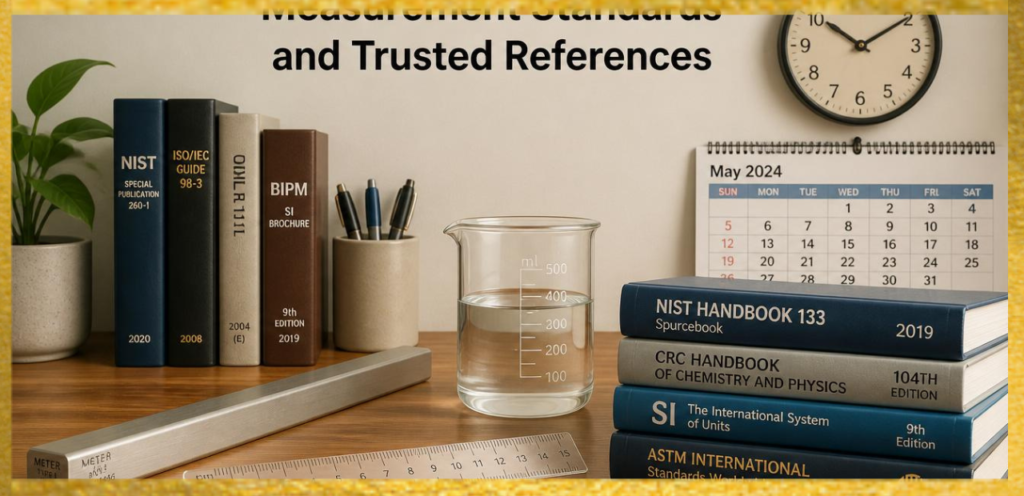
Several respected organizations provide guidance on Scientific measurement and Measurement standards.
These include:
- National Institute of Standards and Technology (NIST)
- Handbook 44
- CK-12 Foundation
- LibreTexts
These resources explain SI measurement, laboratory calculations, density concepts, and metric conversions in greater depth.
Frequently Asked Questions
Can mg be converted directly into mL?
No. You need either the Density or the Milligrams per milliliter (mg/mL) concentration.
Is 1 mg always equal to 1 mL?
No.
Only certain situations involving known concentrations produce that relationship.
Is cc the same as mL?
Yes.
1 Cubic centimeter (cc) equals 1 Milliliter (mL).
Why does the answer change between substances?
Because every material has its own Physical properties, especially density.
Which is more accurate: volume or weight?
For cooking and laboratory work, Mass measurement is generally more accurate than estimating volume.
Read this blog :https://naxovater.com/40-weeks-from-today/
Final Thoughts
Learning how to convert milligrams to milliliters isn’t really about memorizing one magical equation it’s about understanding the relationship between Mass, Volume, and Density.
Once those three ideas click together, conversions stop feeling mysterious and start making genuine sense.
Whether you’re measuring Medication, preparing Cooking ingredients, completing Chemistry calculations, or simply satisfying your curiosity, always remember that the substance itself matters just as much as the numbers.
Two materials with the same Mass can occupy completely different Volumes, and that’s perfectly normal.
Keep a reliable conversion guide, use a quality measurement calculator or unit calculator when needed, and don’t be afraid to double-check important values.
Science isn’t about guessing; it’s about getting close enough that the numbers quietly nod back at you. And honestly, that’s kinda satisfying.