

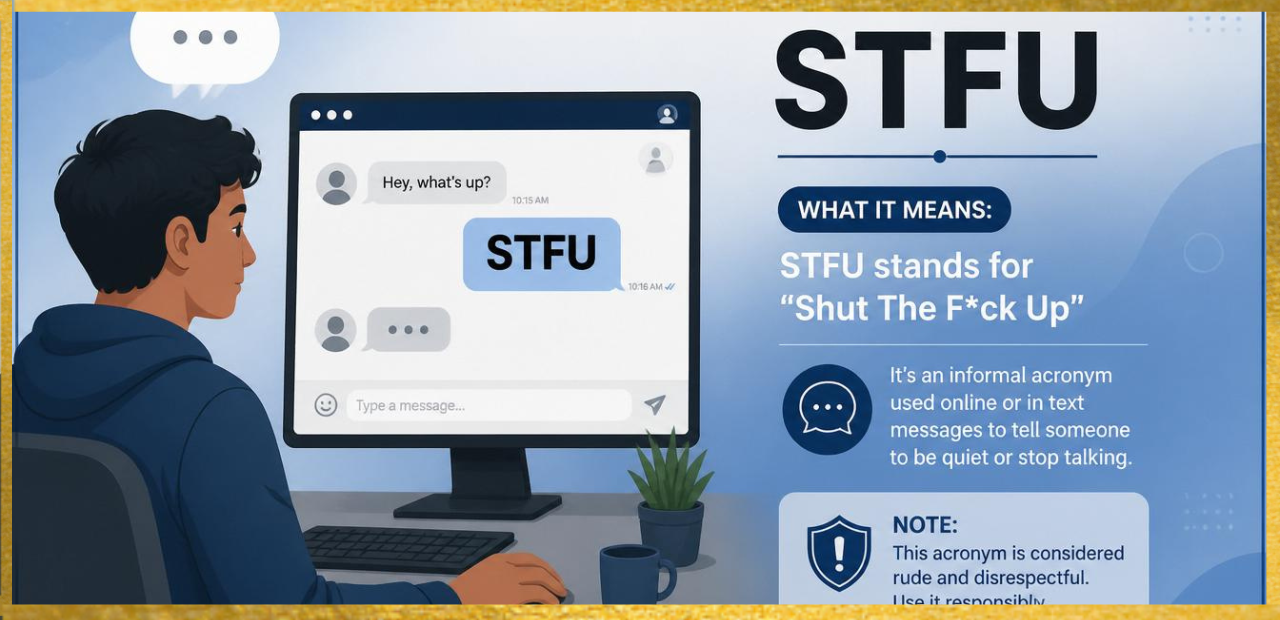
You searched “What does STFU mean in text” because somebody dropped it into a conversation and now you’re trying to figure out whether they were joking, angry, sarcastic, flirting weirdly, or just being aggressively online.
Honestly? Fair question.
STFU is one of those internet slang terms that can swing from hilarious to hostile in about half a second depending on tone, emojis, punctuation, and who’s saying it. A best friend texting “stfu omg” after exciting gossip means something very different from a stranger typing “STFU” in all caps during an argument.
Same letters. Totally different energy.
That’s why people keep searching this phrase every year. The meaning itself is simple. Interpreting it correctly? That’s the tricky part.
So let’s unpack the actual STFU meaning, where it shows up online, why Gen Z keeps using it, and how to tell whether somebody is joking or trying to start digital warfare inside a group chat.
| Term | Full Form | Meaning in Text | Tone |
|---|---|---|---|
| STFU | Shut The F*** Up | Telling someone to be quiet | Rude/Harsh |
| Common Use | Online chats & gaming | Used in arguments or joking | Informal |
| Friendly Use | Between close friends | Can be playful in context | Casual |
| Formal Use | Rarely appropriate | Avoid in professional chats | Negative |
What Does STFU Mean?
STFU stands for:
“Shut The F* Up.”**
Yeah. Direct. Not exactly subtle.
It’s an internet slang abbreviation people use in:
- Text messages
- TikTok comments
- Discord chats
- Snapchat conversations
- Gaming lobbies
- Meme culture
- Social media arguments
Sometimes it’s playful. Sometimes it’s rude. Sometimes it lands somewhere in the chaotic middle where internet humor tends to live now.
That ambiguity is why context matters so much.
Why People Use STFU Online
People shorten phrases online constantly. Speed matters.
Typing “STFU” feels faster, less formal, and oddly softer than spelling out the full phrase completely. Abbreviations create emotional distance. Internet culture does this all the time.
Examples:
- LOL instead of laughing
- IDC instead of “I don’t care”
- BRB instead of “be right back”
STFU works the same way. The abbreviation can make harsh language feel less intense, even though the underlying phrase still contains profanity.
That’s part of why it spread so quickly across texting slang and meme culture.
Why STFU Became So Common
A few reasons pushed STFU into mainstream internet slang:
- Gaming culture normalized fast trash talk
- Meme pages amplified sarcastic humor
- Social media rewards short reactions
- Group chats encourage casual shorthand
- TikTok comments thrive on exaggerated emotion
Online language compresses feelings into tiny bursts now.
“STFU” became one of those bursts.
Is STFU Offensive or Playful?
This is where things get messy.
Technically, STFU is offensive language because it contains profanity and tells somebody to stop talking. In real-world conversation, that can sound extremely rude.
Online? Different story.
Tone changes everything.
Aggressive Usage
Sometimes STFU genuinely means:
“Be quiet.”
“Stop talking.”
“I’m angry.”
Examples:
- “STFU you’re lying.”
- “Bro STFU already.”
- “Nobody asked. STFU.”
In these situations, the phrase is confrontational. Not playful. Not friendly.
Usually easy to spot.
Especially when paired with:
- All caps
- Insults
- Angry punctuation
- Ongoing arguments
Joking Usage Among Friends
Now compare that with this:
- “STFU THAT’S INSANE.”
- “Omg stfu no way.”
- “Stfu you actually met them??”
Completely different tone.
Here, STFU acts more like emotional exaggeration than hostility. It often translates loosely into:
- “I can’t believe it.”
- “You’re joking.”
- “That’s hilarious.”
- “That’s wild.”
Close friends especially use it this way.
Internet humor loves fake aggression between people who are actually comfortable with each other.
Sarcastic Internet Humor
TikTok and meme culture made sarcastic STFU reactions extremely common.
You’ll see comments like:
- “stfu this is adorable.”
- “STFU I NEED THOSE SHOES.”
- “pls stfu this made me cry laughing.”
Nobody’s literally demanding silence there.
The phrase becomes emotional emphasis instead.
Kind of weird linguistically when you think about it too long.
Tone and Context Matter More Than the Words
This matters more than almost anything else with internet slang.
Factors that change STFU’s meaning:
- Friendship level
- Emojis
- Capitalization
- Conversation history
- Platform culture
- Timing
“stfu lol” feels softer than:
“STFU.”
One tiny difference. Huge emotional shift.
STFU Meaning Across Different Platforms
Different apps create different slang behavior. STFU changes slightly depending on where you see it.
STFU on TikTok
TikTok uses STFU constantly.
Mostly for:
- Shock reactions
- Meme humor
- Sarcastic excitement
- Dramatic exaggeration
Examples:
- “STFU this outfit is perfect.”
- “stfu i’m obsessed.”
- “No because STFU that plot twist.”
TikTok comments thrive on exaggerated emotional language. People react dramatically because dramatic comments perform better socially.
Subtlety dies fast there.
STFU on Snapchat
Snapchat conversations are usually more personal and casual.
STFU appears in:
- Friend banter
- Joke reactions
- Group chat teasing
Examples:
- “Stfu send proof.”
- “Omg stfu rn.”
- “STFU you did not.”
Among friends, this often signals excitement rather than anger.
Though obviously not always.
STFU in Gaming Chats
Gaming culture practically helped raise this abbreviation.
Competitive multiplayer games normalized:
- Fast insults
- Trash talk
- Aggressive shorthand
- Meme communication
In gaming lobbies, STFU can range from harmless joking to genuinely toxic behavior within seconds.
Especially in ranked matches. People become philosophers of rage there.
STFU on Discord
Discord mixes meme culture with gaming culture, which means STFU appears constantly.
Common uses:
- Sarcastic reactions
- Community jokes
- Voice chat banter
- Fake arguments between friends
Discord users heavily rely on tone indicators and inside jokes, so outsiders sometimes misread conversations badly.
STFU in Text Messages
Regular texting depends almost entirely on relationship context.
If your best friend texts:
- “stfu you’re gorgeous.”
That’s probably affectionate.
If your boss texts:
- “STFU.”
You may want to update your resume.
Real Examples of STFU in Conversations
Examples help way more than definitions with slang like this.
Funny Examples
- “STFU that dog is wearing sunglasses.”
- “Omg stfu this meme killed me.”
- “stfu why is this so accurate.”
Tone:
Humorous disbelief.
Angry Examples
- “Just STFU already.”
- “Nobody cares. STFU.”
- “STFU and leave me alone.”
Tone:
Hostile. Direct.
Meme Examples
- “STFU I NEED THIS.”
- “pls stfu this edit is insane.”
- “stfu i’m crying.”
Tone:
Dramatic internet humor.
Flirty or Playful Examples
- “stfu you remembered my favorite coffee.”
- “Omg STFU you’re actually cute.”
Tone:
Affectionate teasing.
Internet flirting got weird somewhere around 2018 and never recovered.
How to Know If Someone Means STFU Seriously
You can usually decode intent pretty quickly once you know what signals to watch.
Look at the Tone
Tone is the biggest clue.
Compare:
- “stfu lol”
- “STFU.”
Second one feels colder immediately.
Shorter. Sharper.
Watch Emojis and Punctuation
Emojis soften internet slang constantly.
Examples:
- “stfu ”
- “omg stfu ”
- “STFU ”
Huge difference between those and:
- “STFU.”
Tiny symbols completely reshape meaning online.
Understand Relationship Context
Would this person normally joke with you like that?
Close friends often use exaggerated insults affectionately. Strangers usually don’t get that benefit of the doubt.
Relationship history matters more than the abbreviation itself.
Read the Conversation Flow
Never isolate one message.
Look at:
- Previous texts
- Overall mood
- Current topic
- Conversation pacing
A playful conversation usually stays playful. Heated arguments rarely transform into wholesome comedy halfway through.
Usually.
When You Should NOT Use STFU
Some internet slang belongs in casual spaces only.
STFU absolutely falls into that category.
Workplace Communication
Never send STFU in professional settings.
Not jokingly. Not ironically. Not “as a meme.”
Tone gets misunderstood easily through text, and profanity in workplace chats can create serious problems.
School Settings
Teachers, professors, and administrators generally won’t interpret STFU as harmless meme culture.
Even if your friends would.
Professional Emails
This should go without saying.
But the internet has surprised humanity before.
Spell things professionally in formal communication.
Talking to Strangers Online
Friends may understand your humor.
Random people probably won’t.
Using STFU casually with strangers can escalate conversations fast, especially on social media where tone already gets misread constantly.
Similar Internet Slang Terms
STFU belongs to a huge ecosystem of online abbreviations.
Here are a few related ones:
| Slang | Meaning |
|---|---|
| GTFO | Get The F*** Out |
| IDC | I Don’t Care |
| LOL | Laughing Out Loud |
| LMAO | Laughing My Ass Off |
| IDGAF | I Don’t Give A F*** |
| FR | For Real |
| BRB | Be Right Back |
A lot of modern internet slang revolves around:
- Emotional compression
- Speed
- Humor
- Informality
Short phrases spread faster online because they fit platform behavior better.
Why STFU Became Popular in Internet Culture
Internet culture rewards dramatic reactions.
That’s really the core of it.
Meme Influence
Memes turned exaggerated emotional language into entertainment.
“STFU” became part of reaction culture because it sounds emotionally loud in only four letters.
Efficient chaos.
Gaming Communities
Competitive games normalized fast, blunt communication decades ago.
Gaming slang then spread outward into:
- Discord
- TikTok
- Snapchat
- Group chats
A lot of modern slang traces back to gaming communities more than people realize.
Fast Communication Online
Shorter language survives better online.
Especially in:
- Comments
- Livestream chats
- Multiplayer games
- Group conversations
Attention spans move fast. Slang adapts accordingly.
Gen Z Humor Styles
Gen Z humor heavily relies on:
- Irony
- Fake aggression
- Emotional exaggeration
- Chaotic reactions
That’s exactly why STFU keeps thriving on TikTok and meme pages even years later.
Frequently Asked Questions
What does STFU stand for?
STFU stands for “Shut The F*** Up,” an internet slang abbreviation commonly used in texting and social media.
Is STFU rude?
It can be. Tone determines everything. Friends often use it jokingly, while arguments make it sound aggressive.
What does STFU mean on TikTok?
On TikTok, STFU usually appears in sarcastic reactions, memes, dramatic comments, or playful banter.
Is STFU a bad word?
Yes. It contains profanity and is generally considered inappropriate in formal communication.
Can STFU be used jokingly?
Absolutely. Many friends use STFU humorously online, especially in meme culture, gaming chats, and TikTok comments.
Frequently Asked Question
what stfu mean in text message
STFU means “Shut The F*** Up” in text messages. It can sound rude or playful depending on the conversation tone and the relationship between the people chatting.
what does stfu mean in text
In texting slang, STFU is a short form of “Shut The F*** Up.” People often use it jokingly, sarcastically, or during online arguments.
stfu meaning slang
As internet slang, STFU is used to express shock, excitement, annoyance, or humor. The meaning changes based on context, emojis, and how the message is written.
what does stuf mean in text
“STUF” is usually a typing mistake for “STFU.” Most people actually mean “Shut The F*** Up” when using it in chats or social media comments.
stfu meaning in text
The meaning of STFU in text is “Shut The F*** Up.” It’s commonly seen in TikTok comments, gaming chats, Snapchat messages, and casual online conversations.
Final Thoughts
STFU is one of those internet slang terms where the dictionary definition only tells half the story.
Technically, it means:
“Shut The F*** Up.”
But online culture reshaped it into something far more flexible:
- Joke reaction
- Meme response
- Sarcastic exaggeration
- Friendly teasing
- Actual insult
That’s why context matters so much.
The same four letters can either start a fight, end a fight, or somehow become a compliment inside a TikTok comment section full of people yelling affectionately at strangers about oversized hoodies and emotionally devastating cat videos.